
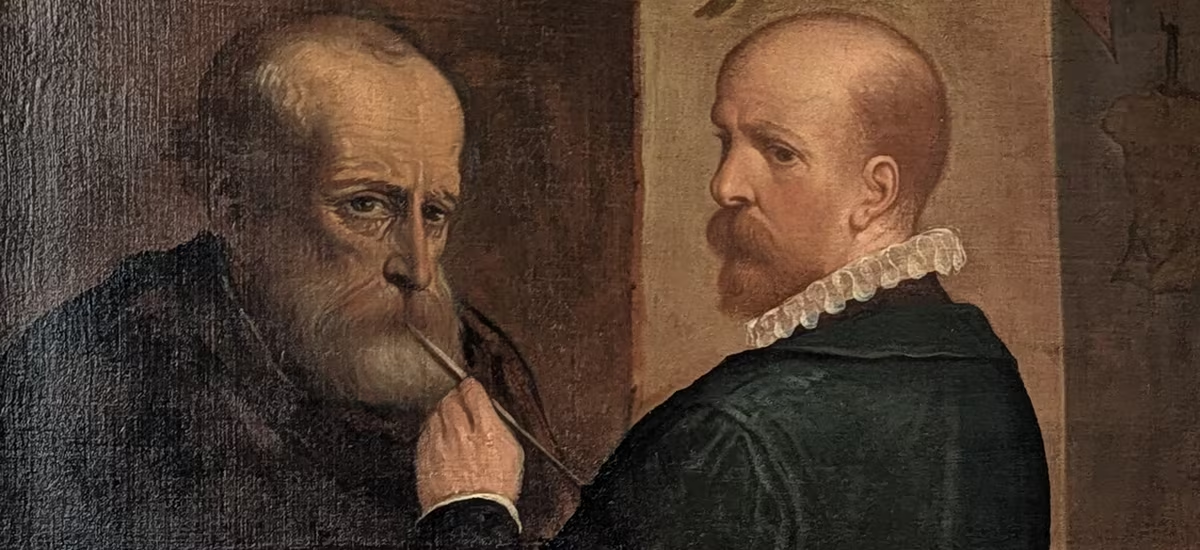
Genoa, 16th century. The city’s merchant aristocracy is flush with money and hungry for grandeur. Palaces are rising along the new Strada Nuova, church ceilings are bare and waiting. The Doria family, the most powerful name in town, wants art that announces its ambitions to the world. Into this scene walks Luca Cambiaso – known around Genoa simply as Lucchetto da Genova (Little Luke of Genoa) – a painter’s son from a Ligurian fishing village, who will spend his life covering Genoa’s walls from floor to vault and end his days painting heaven itself at the Spanish royal court.
Born into paint.

Cambiaso was born on 18 October 1527 in Moneglia, a small coastal village about 50 kilometres east of Genoa, on the Riviera di Levante. His father Giovanni was a painter from San Quirico, a village in the Val Polcevera, the inland valley that runs north from Genoa’s western edge toward the Apennines. When troops of the Constable of Bourbon swept through the region, Giovanni fled, not to Genoa itself, but east along the coast, landing in Moneglia. That is where Luca was born and where, for a time, the family stayed.
Giovanni was not a great painter, but he was a thoughtful teacher. He set his son to copying Renaissance drawings, modelling figures in clay, and – most importantly – studying the frescoes that Perin del Vaga, Beccafumi and Pordenone had just completed at the Palazzo Andrea Doria in Genoa. The city, even from fifty kilometres away, was already the gravitational centre of Luca’s world. By the age of fifteen he was co-signing work with his father. By seventeen he was helping decorate a Doria palace.
The Michelangelo obsession.
Like every ambitious painter of his generation, Cambiaso fell hard for Michelangelo. He travelled to Rome, studied the Sistine Chapel, then headed north through Emilia to absorb Correggio and Parmigianino. He never studied under Michelangelo directly, but he absorbed the master through prints, drawings and the talk of other painters.
The early work shows it: muscles straining, limbs twisting, compositions piling up with furious energy. A kind of magnificent heaviness. He knew it wasn’t quite right, and he spent the rest of his life finding his own way out.

The cube method.
Somewhere in his thirties, Cambiaso hit on something unusual. Struggling to master foreshortening and spatial perspective, the perennial headache of Mannerist painters, he started reducing the human body to geometric essentials: cubes, cylinders, rectangular blocks. His sketchbooks from this period look almost robotic: square heads, boxy torsos, limbs like architectural elements.
It sounds reductive. In practice it was liberating. Once the geometry was locked in, figures could be placed in space with a confidence few contemporaries matched. In his mature paintings, the cubes dissolve back into flesh, softened by light, wrapped in an amber warmth that feels almost cinematic. The scaffolding disappears, and only the solidity remains.
To modern eyes, these drawings read as almost proto-cubist. They are certainly unlike anything else being produced in sixteenth-century Italy.
The master of candlelight.
That warmth brings us to what Cambiaso is perhaps most quietly remarkable for: his nocturnal scenes. Works like the Madonna of the Candle show a single light source – a flame, the glow of the Christ child – illuminating faces from below while everything around falls into deep, velvety shadow. The effect is intimate and technically daring for the period.
This particular kind of luminism, developed within the Genoese Mannerist tradition, would go on to inspire Georges de La Tour, the great French master of candlelit devotion, two generations later. Cambiaso never got the credit, but La Tour did.
The man who built the Genoese school.
Cambiaso is considered the founder of the Genoese school of painting, the figure who established a local tradition of large-scale fresco decoration that would shape the city’s artistic identity for over a century, and whose students and followers fed into the wider current of European Baroque.
His key partner in building this legacy was Giovanni Battista Castello, known as “il Bergamasco.” Together they worked the length of Genoa’s ambitions: the church of San Matteo, private villas, the grand interiors of the palaces on what is now Via Garibaldi. Their working relationship was so close that contemporary critics struggled to tell their frescoes apart. When Castello left for Spain in 1566, Cambiaso finished their shared projects alone, including the Lercari chapel in the Duomo di San Lorenzo.
He was also a generous teacher. Among his students: Battista and Bernardo Castello, Giovanni Battista Paggi, Francesco Spezzini, Lazzaro Tavarone. His influence on Genoese painting extended well past his own death.
A life complicated by love – and thousands of drawings.
Cambiaso drew with an intensity that bordered on compulsion. A contemporary noted that his wife and servant used discarded sheets to light the household fires, and that it was only thanks to a devoted student that a significant number were rescued from the flames. He produced more drawings than almost any artist of his era. His reputation as a draughtsman was such that everything – student copies, workshop imitations, later pastiches – eventually got attributed to him. Of 188 drawings once catalogued under his name at the Louvre, modern scholarship accepts only 26.
His personal life had its own complications. After his wife died, his sister-in-law took charge of the household. Cambiaso fell in love with her. He applied to Rome for a papal dispensation to marry her, but Rome said no. Some reckon it was his main reason for accepting Philip II’s invitation to Spain in 1583: the hope that royal influence might eventually sway the Vatican. It didn’t. He died at the Escorial in 1585, dispensation never granted, paint still drying on the vault above him.

Why he was forgotten.
Cambiaso has one of those reputations that art historians keep meaning to restore and never quite do.
Part of the problem is geography: Genoa, for all its sixteenth-century wealth, was not Florence or Venice. Its art stayed in the city.
Part of it is the sheer volume of his output: when you produce thousands of drawings and decorate dozens of buildings, no single image defines you.
And part of it is the cruel joke of influence: the things he pioneered, like the geometric method or the candlelit intimacy, were taken up by others who became more famous for them. He was the precursor of an entire school; but never really got the name to go with it.
Where to see Lucas’Cambiaso paintings in Genoa – and beyond.
For anyone spending time in Genoa, Cambiaso is everywhere, hiding in plain sight. The Palazzo Doria (today the Prefettura) on Via Balbi shows early work done alongside his father. The Duomo di San Lorenzo holds the Lercari chapel frescoes (1569), among the finest of his mature years. The Palazzo Bianco keeps several canvases, including the Madonna of the Candle. The Villa Imperiale at Sampierdarena still has his Rape of the Sabines (1565) in situ as a fresco. Some of his works decorate the vaults of the Church of San Matteo.
Beyond Genoa: the Louvre holds Venus and Adonis and a large drawing collection; the Prado in Madrid has The Arrest of Christ; the Uffizi in Florence rounds out the major holdings. And those making it to the Escorial, near Madrid, can admire his final achievement: the Coronation of the Virgin and Glory of the Blessed on the vaulting of the church.