
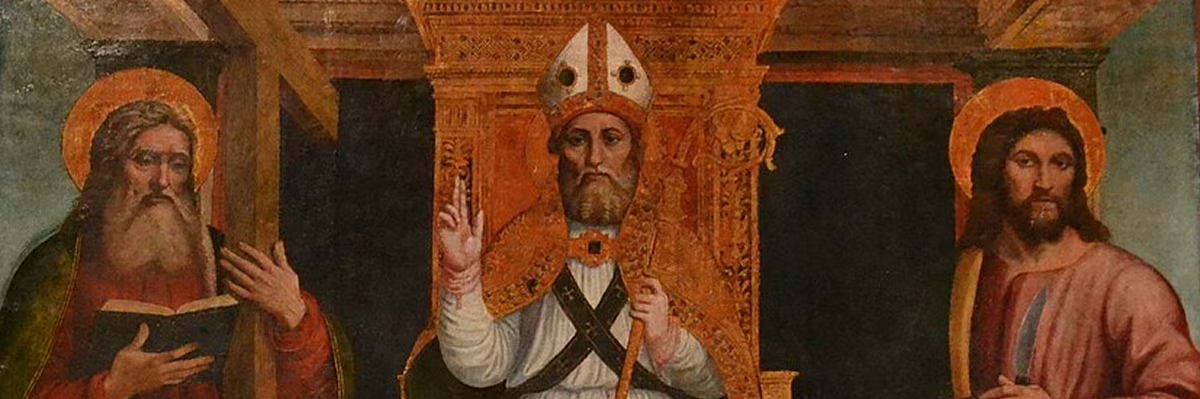
Genoa in the early sixteenth century was a city hungry for art but short on local talent. The great Genoese school that Cambiaso would later build was still decades away. Into this gap came Pier Francesco Sacchi, a tailor’s son from Pavia, trained in Lombardy, shaped by Flemish painting, and unlike anyone else working in the city at the time. His figures are still and absorbed, his surfaces almost obsessively precise, his palette as saturated as a manuscript illumination. He died of plague aged forty-three, leaving behind barely a dozen works. And every one of them is worth tracking down.
From Pavia to Genoa, aged sixteen.
Pier Francesco Sacchi was the son of a tailor, born in Pavia around 1485. There was no obvious path to painting, except perhaps an older brother, Giovanni Angelo, who had already set up a modest workshop back in Pavia. Whatever the family’s early influence, Sacchi quickly outgrew it. He likely trained first in Lombardy, absorbing the calm, classical tradition of painters like Vincenzo Foppa and Bernardino Luini. In 1501, at barely 16 years old, he moved south to Genoa before making the move south to Genoa to become the apprentice to a local painter named Pantaleone Berengario.
The city suited him. Its merchant patrons wanted devotional art – altarpieces, chapel paintings, figures of saints – and Sacchi had exactly the temperament for it: patient, precise, and deeply attentive to the human face. He became a member of the Genoese guild of painters in 1520, by which point he had already been working in the city for nearly two decades. He signed his paintings “de Papia” – from Pavia – right to the end, as if to remind Genoa, and perhaps himself, where he had come from.
A style unlike anyone else in Genoa.
What makes Sacchi genuinely distinctive is the collision of influences running through his work. His detailed, sharply delineated, naturalistic – almost hyperreal – style reveals a regard for Northern European painting, while the sources for his figures and other influences are derived from Lombardy, Liguria and Flanders.
In practice this means paintings where the theology is Italian and the surfaces are Flemish. Look closely at any of his altarpieces and you find faces painted wrinkle by wrinkle, hands rendered tendon by tendon, objects (inkpots, leather-bound books, carved lecterns) described with the loving precision of a manuscript illuminator. Every crease around the eyes and each bone and tendon in the neck is carefully recorded, revealing not only his acute powers of observation but also his understanding of anatomy.
This was not the muscular drama of Michelangelo’s influence that dominated much Italian painting of the period. Sacchi’s figures are still, absorbed, quietly going about their business – a scholar reading, a saint writing, doctors of the church seated around a table as if in a monastery scriptorium. The mood is contemplative rather than theatrical.
A plague year ending.
The summer of 1528 was brutal in Genoa. Plague had been moving through the city and Sacchi, like many, retreated to Albaro, the hillside suburb east of the centre, hoping to sit it out. He didn’t make it. He died there that summer, aged around forty-three, shortly before his younger brother Battista, whom he had trained himself over seven years. Two painters from the same family, gone within weeks of each other.
He left behind no school, no documented students beyond his brother, and a catalogue of works so small that attribution debates continue to this day. But what he left in Genoa – above all the altarpiece at Santa Maria di Castello – is enough to make a strong case for a longer visit.
Where to find his works.
His career in Genoa produced a small but remarkable body of work, a part of it still in the city. However, some significant works are now abroad. His earliest surviving painting, the Calvary (1514), is now in the Gemäldegalerie in Berlin. The following year he painted an altarpiece commissioned by a Knight of Jerusalem for the church of San Giovanni di Prè in Genoa. The central panel is now at the Louvre in Paris.
In 1526 he painted the Madonna Odigitria with Saints for a chapel in Santa Maria di Castello in Genoa – one of the few works that can still be admired in the very church for which it was made. A year later came what is generally considered his masterpiece: a large Deposition for the church of Monte Oliveto at Multedo, now Genoa Pegli, praised for its compositional complexity and emotional restraint.
Saint Paul Writing, a late work from the 1520s showing his mature style at its most concentrated, is now in the National Gallery in London.
Picture credit (image modified): Carlo Dell’Orto, CC-by-SA 4.0