
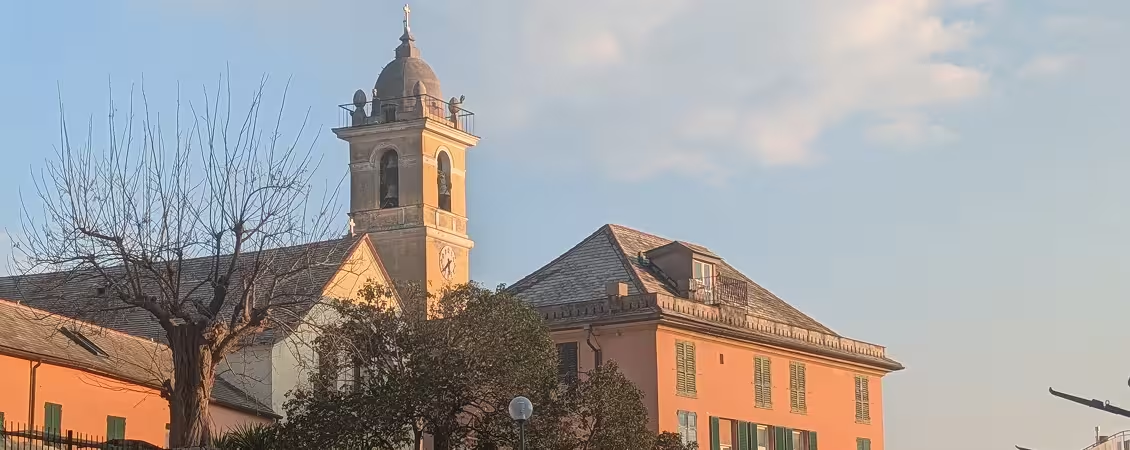
The Church of San Rocco sopra Principe, or San Rocco di Granalaro, dominates the San Theodoro district and the Principe area. It is mainly remarkable for the stucco decorations of its interior from the early 16th century.
Church address.
Salita S. Rocco, 28
Best time for sun lighting
Afternoon
Note
As of 2026, some works are ongoing on the choir, which is only partially visible.

History of San Rocco sopra Principe.
First mentioned in 1316, a chapel dedicated to Saint Margaret already stood on this site, attached to a monastery of Augustinian nuns. In the mid-14th century, the monastery changed hands and passed to the Lateran Canons, who also followed the rule of Saint Augustine. In 1509, they moved to the more central convent of Sant’Andrea. They were substituted by the Lateran Canons of San Teodoro, who commissioned the lavish stucco decoration that still adorns the interior today. By 1555, it had been handed over to the Apostolini order, who rededicated the church to Saint Roch – the name it bears to this day.
Following the suppression of their order, the church passed to the Minor Regular Clerics of the Holy Faith in 1660, who kept it alive until the sweeping dissolution of religious institutions in 1797 brought their tenure to an abrupt end. After more than two decades of closure, the church was finally reopened for worship in 1821 and reestablished as a parish. It was damaged by bombings during the Second World War, especially on August 2, 1944.
Visiting the church.
Except for its bell tower, recognizable from afar, the exterior of the church is quite unremarkable.
Its interest lies mainly inside. The single nave is decorated with stucco work by Marcello Sparzo, dating to 1514. Born in Urbino, Sparzo was considered one of the finest stucco artists of his time. He worked primarily in Urbino, Turin, Siena, Pavia and Genoa, where he contributed to the decoration of San Pietro in Banchi and the Palazzo del Principe. Alongside his impressive stucco work, the frescoes on the vault of the apse depict scenes from the life of Saint Roch, painted by Giovanni Carlone (1584–1631).
The church also houses several other important artworks. A marble statue of Saint Roch is attributed to the French sculptor Honoré Pellé, dating to around 1700. Several paintings originate from churches demolished over the centuries, among them Saint Luke Painting the Virgin by Giovanni Andrea Ansaldo, The Crucifix and the Magdalene by Luciano Borzone, The Death of Saint Joseph by Giovanni Andrea De Ferrari, The Dormition of the Virgin by Domenico Fiasella, The Beheading of the Baptist by Giovanni Battista Merano, and Virgin and Child by Nicolò da Voltri.
Four doges of the Republic are buried in the church: Benedetto Viale (1717-1719), Agostino Viale (1750-1752), Gian Carlo Pallavicini (1785-1787), and Alerame Pallavicini (1789-1791).