
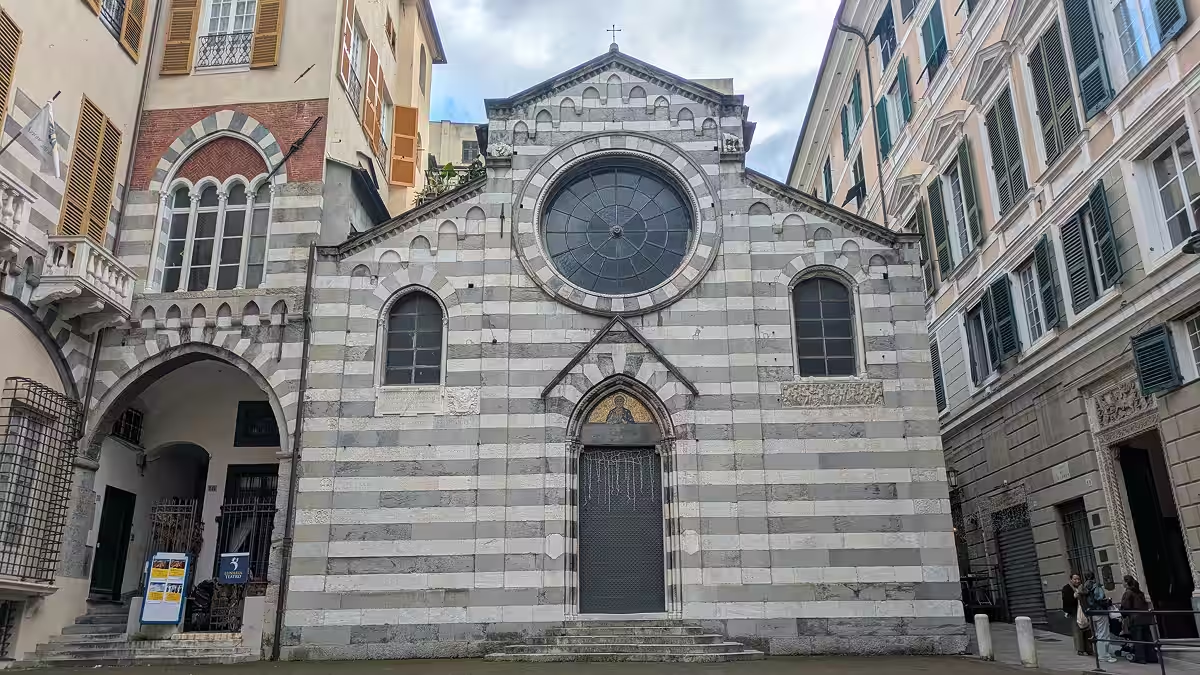
A few steps from the Doge Palace and San Lorenzo Cathedral, Piazza San Matteo serves as a rare urban “island” belonging to a single dynasty: the Doria. During Genoa’s first golden age, this powerful maritime clan transformed the area into a private estate. Unlike public squares, this space was a coordinated family headquarters where the Doria erected their palaces around a central family church. It remains one of the most authentic examples of a medieval aristocratic quarter in Europe, illustrating the architectural manifestation of dynastic power. It’s also among the most atmospheric corners of the old town – and one of the stops I always recommend in my complete guide to things to do in Genoa.
Church address.
Piazza di S. Matteo, 18
Church Opening times.
Tuesday – Saturday
10 am to 12pm and 3pm to 7pm.
Sunday 9am to 12pm.
Cloister Opening times.
Best time for sun lighting
9.30 am – 13.30 pm
Why the square and church are a must-visit.

- Doria Legacy: the square was the power´s core of the Dora family, one of the most powerful dynasty of Genoa.
- Frozen in time: for over 700 years, the facades have remained almost untouched, preserving a pure medieval soul
- Iconic art and architecture: Marvel at the iconic black-and-white horizontal stripes, the porches of the palaces and the artworks inside the church and the cloister
- Literary infamy: Walk the grounds of Branca Doria, a man so infamous that he earned a special place in Dante´s inferno
- The resting place of Andrea Doria, the “Father of the Fatherland” and Genoa´s most formidable leader.
The private sanctuary of the Doria dynasty.

The Church San Mateto was founded in 1125 by Martino Doria as the private chapel of his family and a priory dependent of the San Fruttuoso abbey – another incredible landmark of the greater Genoa area. The church, in the heart of the family enclave, played an important place in the Doria´s symbolism and became a place of burial for several of its members.
In 1278, as part of the restructuration of the enclave, it was renewed and acquired the elegant facade with white and black stripes that we can still admire today. However, its interior lost most of its gothic character when Andrea Doria had it remodelled in the mid-16th century, becoming a jewel of Renaissance and Baroque decorations.
Next to the church, the cloister was erected at the beginning of the 14th century and reminds that the church was originally part of a priory, before becoming later a collegiate church.
Significant artworks inside the church.
The facade of the church is simple and presents the style of the 13th century also recognizable in other monuments of the city and its region. The facade alternates white stripes made of marble with black stripes. Two windows, a big rosace and the entrance opens in its facade, which features above the door a 13th century mosaic. The walls are covered with inscriptions praising the Doria, and a Late Roman sarcophagus is was embedded in the walls to become the tomb of Lamba Doria, a famous admiral.
Inside, the Renaissance decoration features a key artwork from the genoese artists and friends, Luca Cambiaso (The Miracle of the Ethiopian Dragon), and Giovanni Battista Castello (The Vocation of Saint Matthew). Other artists are represented, like Montorsoli who conceived the crypt and many sculptures in the church, as well as the tomb of Andrea Doria and his wife Peretta Usodimare. The church also features organs dating back to 1773.
Main artists represented at San Matteo.
The medieval Cloister.
The cloister features numerous remains of funerary monuments belonging to members the Doria family. Many of them originate from the nearby church of San Domenico, a major religious building of Genoa which was destroyed in the 19th century.
