
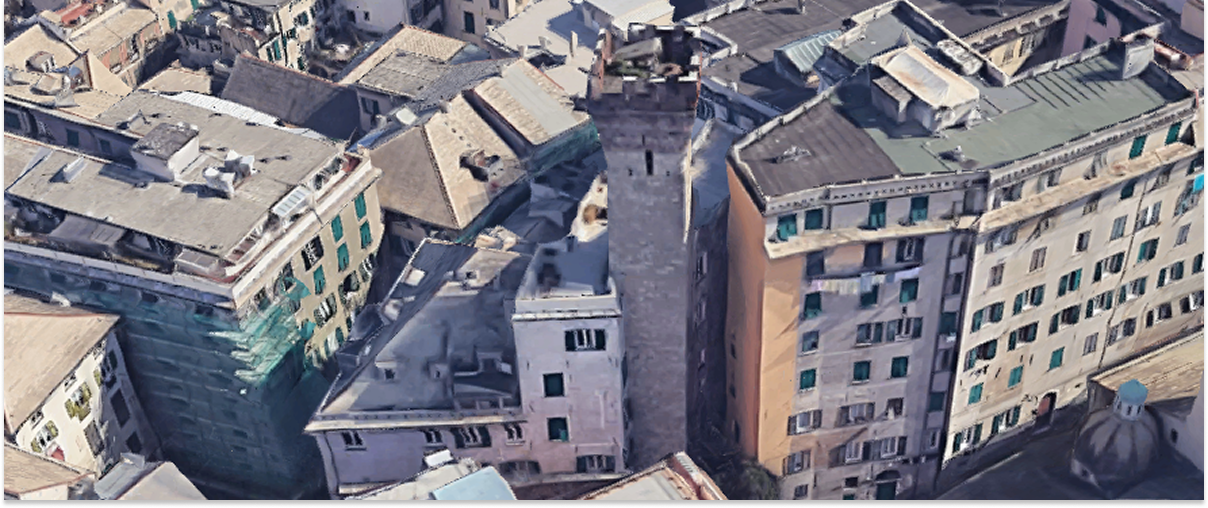
In the heart of Genoa’s oldest district, the Castello, stands a monument that tells a story of prestige, mistaken identity, and survival. Reaching a height of 41 meters, the Torre dei Castro – often misnamed the Torre degli Embriaci – is the only medieval skyscraper in the city that remained untouched by the draconian laws of the 12th century.
A case of mistaken identity.
For centuries, local tradition attributed this massive stone structure to Guglielmo Embriaco, the legendary hero of the First Crusade. It was said that the tower was built with the riches seized during the conquest of Jerusalem in 1099. However, modern research has corrected the record. The actual Embriaci tower was located in Piazza di Santa Maria in Passione, while this specific palace-tower belonged to the noble dei Castro (or Castello) family.
Despite the historical correction, the name “Embriaci” remains etched in the local collective memory, forever linking the tower to the crusading glory of the Middle Ages.
The 1196 Edict: Cutting the skyline.
In 1196, the Podestà Drudo Marcellino issued a radical decree to curb the arrogance of Genoa’s feuding noble families. He ordered that no private tower could exceed the height of 80 spans (approximately 20 meters). This led to a massive “decapitation” of the city’s skyline; of the 66 towers that once pierced the clouds, almost all were cut in half.
The Torre dei Castro was the sole exception. Standing at 165 spans (41 meters), it was spared – either out of respect for the family’s influence or, as historian Federico Alizeri suggested, out of “pity for such a singular monument.” A marble plaque placed at its base in 1869 by Ludovica Brignole-Sale still commemorates this rare exemption.
Architectural mastery and restoration.
Built at the beginning of the 12th century, the tower utilizes massive blocks of rusticated stone, likely repurposed from the abandoned 9th-century city walls. Its design features:
- Triple-arched cornices: A unique aesthetic where overlapping rows of small hanging arches crown the summit.
- Defensive slits: Narrow openings in the stone walls designed for both light and defense.
- Guelf Battlements: Added during a 1926 restoration by Orlando Grosso, these square merlons give the tower its current iconic “medieval” silhouette, though they were not part of the original 1100s design.
From fortress to Renaissance palace.
As the centuries passed and the need for private fortresses faded, the tower was integrated into the Palazzo Giulio Sale (later Brignole Sale). The complex evolved from a defensive domus into a prestigious residence.
- In 1583, Giulio Sale renovated the palace to meet Renaissance standards.
- In the 1600s, Doge Giovanni Francesco Brignole I further transformed the interiors, commissioning frescoes attributed to Giovanni Andrea Ansaldo.
Today, the Torre dei Castro remains the most monumental element of the Embriaci district. It serves as a silent witness to a time when Genoa’s nobility measured their power in stone and height, reminding us of a skyline that once rivaled the most fortified cities of the medieval world.