
The Palazzo Lercari-Parodi, also known as Palazzo Franco Lercari, is one of the finest examples among the Palazzi dei Rolli, sitting at the heart of 16th-century Genoa’s most prestigious address: Via Garibaldi. Its construction was commissioned in 1571 by Franco Lercari, a wealthy banker who went on to serve as Governor of the Genoese Republic in the 1570s. The palace remained in his family’s hands for nearly three centuries, until 1845, when the banker Bartolomeo Parodi acquired it – and his descendants still own it to this day.
That kind of continuity is rare. So is the building itself. Under protection since 1941, it was recognised in 2006 as one of the 42 Palazzi dei Rolli to receive UNESCO World Heritage status, a distinction that feels entirely deserved the moment you step inside.
Palace address.
Via Garibaldi, 3
Note.

Brief history of the palace.
The palazzo was commissioned by Franco Lercari in 1571. A wealthy banker and Governor of the Genoese Republic during the 1570s, Lercari was also the driving force behind two other landmarks that still bear his name: the Villa Lercari in Sampierdarena and the Lercari Chapel in the apse of the Cathedral of San Lorenzo – a man who clearly knew how to leave his mark on a city.
In 1586, he bequeathed his entire estate to Francesco Maria Imperiali di Francavilla, with one condition: that the heir adopt the Lercari surname. The line eventually passed to Maria Luigia, the last of the Imperiali Lercari, who brought the palazzo as part of her dowry upon marrying the Modenese marquis Lodovico Coccapani, thereafter known as Coccapani Imperiali. It was their descendants, Ercole and Lodovico Coccapani Imperiali, who finally sold the palace in 1845 to the banker Bartolomeo Parodi, whose family owns it to this day.
The facade and exterior of the palace.

The architect behind the palazzo remains unknown, but whoever he was, he clearly wasn’t interested in blending in. Unlike its neighbours along the Strada Nuova, the building announces itself through diamond-point rustication on the lower facade – a bold, almost aggressive texture that sets it apart from the street’s more restrained palaces.
The upper floors were originally open loggias, as Rubens captured in his 1652 engravings of Palazzi di Genova, before they were glazed over and eventually bricked up entirely in the early 19th century.
The portal is the work of sculptor Taddeo Carlone, and it comes with a story. It’s held up by two telamones (male stone figures) whose noses have been deliberately mutilated. This is a direct reference to the legend of Megollo Lercari, an ancestor of the patron who exacted revenge on his enemies by cutting off their noses and ears. It’s an unusual choice of welcome, maybe even a warning for not messing with the family.
Inside the palace.
First Floor.
Climbing to the first of the two piano nobile floors, you’re greeted in the loggia by busts of Franco Lercari and his wife Antonia De Marini, both by Carlone, flanked by portraits of Emperor Charles V and King Philip II of Spain, a statement of wealth, loyalty, and ambition all at once.

The fresco cycle here is the work of Lazzaro Calvi and his brother Pantaleo, dating from the late 16th century. Airy landscapes line the walls, while the vault is given over to military scenes drawn from Roman history: the Challenge of the Horatii and Curiatii, Curtius Rufus, and Horatius Cocles. Further rooms on this floor were also frescoed by the Calvi brothers with biblical episodes, but the undisputed highlight is a room painted by Luca Cambiaso, whose vault tells the Stories of Niobe with a restless, almost theatrical energy.
Second Floor.
The second floor opens with a loggia whose original decoration has mostly been lost to time – all except one survival worth noting: Ottavio Semino’s Gigantomachy on the vault, intact and still commanding. Semino also painted the Biblical Stories of King David nearby, while the Calvi brothers return with their own biblical cycle in the Sala del Moltiplico Lercari.
The Main Hall and the Enterprise of Megollo Lercari.
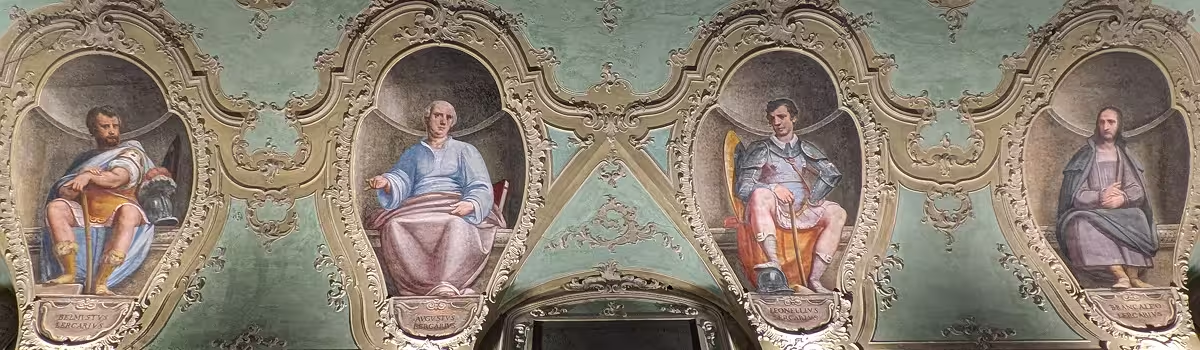
The best is saved for last. On the vault of the main hall of the second piano nobile hangs one of the defining works of Genoese Mannerism: Luca Cambiaso’s fresco of The Enterprise of Megollo Lercari, depicting the construction of the Genoese trading post in Trebizond, a crucial foothold for Black Sea commerce. Surrounding the central scene, portraits of Illustrious Ancestors of the Lercari family line the edges, turning the ceiling into something between a family tree and a propaganda campaign.
There’s also a subtler layer to the image: the fresco doubles as an allegory for the construction of the palazzo itself on the Strada Nuova, offering a rare visual record of what the street looked like in the years of its opening. A painting about building, inside the building it’s about.


