
Genoa rarely makes it onto the standard Italian itinerary. Visitors pass through on their way to the Cinque Terre or the French Riviera, grab a focaccia, and move on. That’s their loss. The old city – a dense labyrinth of caruggi, the narrow medieval lanes that thread between towering palazzi – rewards those willing to slow down and look up. Beyond the Palazzo Ducale and the cathedral – the big-name sights I cover in my complete guide to Genoa – a quieter Genoa persists: forgotten courtyards, small squares that trap the light, frescoes that have outlasted empires, and a Romanesque hill that has watched over the city since the Crusades. This is a guide to nine of the Ligurian capital’s hidden gems, grouped into three short walks you can do separately or string together across a slow day.
Walk 1 – Around the Cathedral.
A tight loop in the heart of the caruggi, a few steps from San Lorenzo, where the medieval city is at its densest.
Piazza delle Scuole Pie, a theatrical square in the heart of the caruggi.
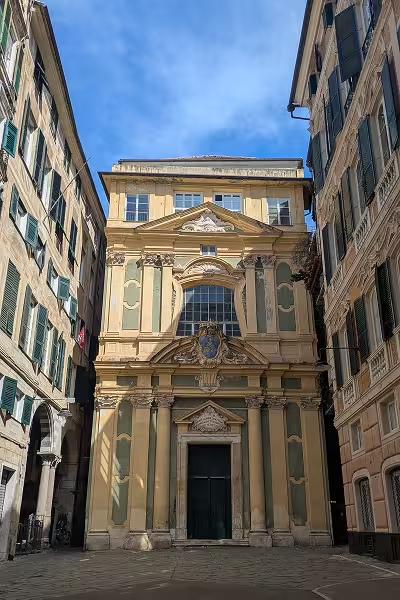
Tucked away deep inside the caruggi lies Piazza delle Scuole Pie, a small pocket of history that feels like a reward for getting lost. Incredibly, this hidden square sits just a stone’s throw from the grand San Lorenzo Cathedral, yet it is completely overlooked by the crowds rushing down the main path. Step inside, and the dense alleyways suddenly open up, trapping the Mediterranean light like a theatrical stage set. It is a place of delightful contrasts: the late-baroque columned facade of the Church of the Scuole Pie sits at the heart of the square, framed by the monumental facades of the palaces of the Cicala family. The surrounding walls feature playful trompe-l’œil frescoes, strengthening the impression of standing inside a theatre. What makes this piazza truly unique, though, is its unexpected appearance and peaceful energy. It is a rewarding discovery, right in the heart of the city.
When to go: an open square, so any time – but if you come around midday, you will see the trompe-l’œil come alive thanks to the high sun.
Galleria Imperiale, an antiques shop inside a frescoed Renaissance palace.
Not every hidden gem is a monument – some are still open for business. On Piazza Campetto, a few steps from San Lorenzo Cathedral, an unassuming antiques gallery occupies the ground floor of the Palazzo Imperiale, one of the city’s grand 16th-century Rolli palaces, built around 1560 and frescoed by Giovan Battista Castello (il Bergamasco) and Luca Cambiaso. Push open the door of the Galleria Imperiale and you step straight into that history: vaulted, stuccoed ceilings arch over rooms crammed with antique furniture, silver, carpets and old-master paintings – pieces ranging from the 17th century to the 20th, with the occasional Schifano or Luzzati among them.
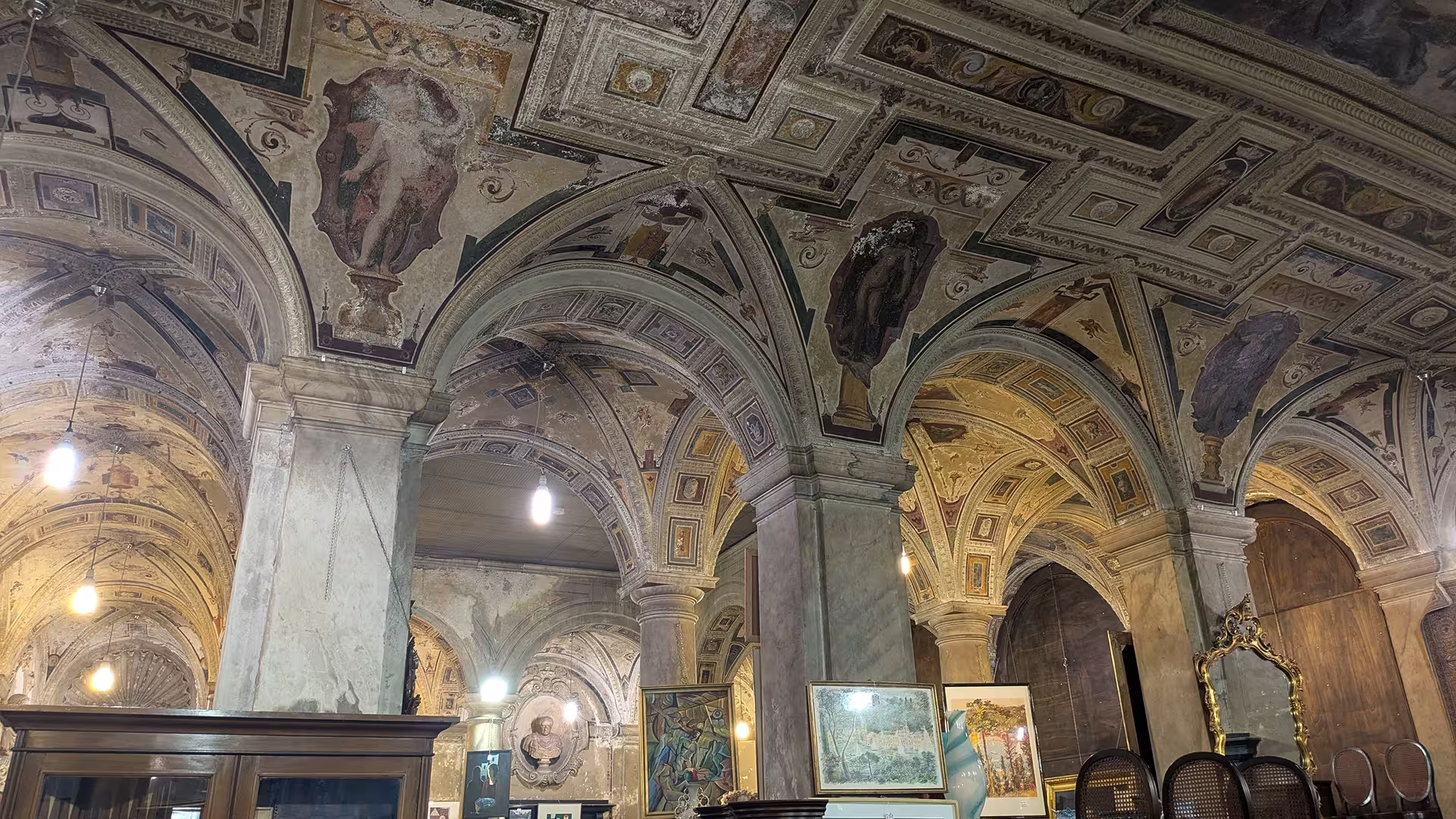
When to go: roughly Tuesday–Saturday 10:00–12:30 and 15:30–19:30, Monday afternoons only, closed Sunday. Browsing is free.
Run since 1978 by the Mengoni family, it is part shop, part private museum, and entirely free to wander. Most visitors never realise that one of Genoa’s most atmospheric Renaissance interiors is hiding behind a shop window – which is precisely the kind of discovery this city rewards
Chiostro di San Matteo, the most elegant of the cloisters hidden in the medieval fabric.

If you are willing to look slightly beyond the striking black-and-white striped facade of the Church of San Matteo — the historic heart of the powerful Doria family’s private square – you will find one of Genoa’s most enchanting medieval secrets. Stepping through an unassuming doorway to the left of the church reveals the Chiostro di San Matteo, a 14th-century cloister that instantly cuts through the noise of the surrounding city. Built in 1308, this quadrilateral oasis features pairs of elegant, slender columns crafted from white marble and black stone that hold up delicate pointed brick arches. The geometric precision of the colonnade framing a quiet central garden creates an unforgettable sense of peace, making it a spectacular architectural discovery completely hidden from the hurried glance of regular tourists.
When to go: the cloister is reached through the church, which keeps limited hours (often only a couple of mornings/afternoons a week, plus weekend mass) — worth checking the parish times before you go. If it is closed, you can still have a (very slight) peek at it from the square, by going in the vaulted hallway to the left of the church.
Walk 2 — The Castello Hill.
The old acropolis: the oldest, most layered ground in Genoa, climbing from Roman ruins to the medieval hilltop and back down to a haunted square. Save your appetite – lunch is built in.
San Donato & the Giardini Luzzati, a Romanesque church next to Roman ruins.
Halfway between the cathedral and the Castello hill, the church of San Donato is easy to walk straight past – which is exactly why so few visitors step inside. Built at the beginning of the 12th century on the foundations of a much older church, it is widely held to be the finest surviving example of Genoese Romanesque architecture. Its glory is the octagonal bell tower, banded with saw-tooth friezes and three tiers of slender superimposed columns, one of the most beautiful in the city. Inside, the austere striped nave hides an unexpected treasure: the Triptych of the Adoration of the Magi, painted around 1515 by the Flemish master Joos van Cleve for the Genoese nobleman Stefano Raggio – a jewel of Northern Renaissance painting, and a reminder that medieval Genoa’s trading networks reached all the way to Flanders.
Step out of the church and you are in the oldest, most layered ground in the city – and, a minute away, its most surprising. The Giardini Luzzati, named after the beloved Genoese illustrator and set designer Emanuele Luzzati, are the largest open-air square hidden in the dense medieval centre, and the city’s unlikeliest success story. The space was first torn open by the bombs of the Second World War and left in ruins for decades; then, in the 1990s, digging for an underground car park accidentally broke into two thousand years of history, uncovering Roman remains that include part of an amphitheatre. Rather than pave over it, local cooperatives turned the whole site into a kind of open-air community living room. By day, children play football and neighbours drink espresso under string lights and olive trees, the excavated ruins fenced right into the scene; by night it fills with live music, street art and students. There is an urban garden, a small theatre and a community bar — daily life carrying on, quite literally, on Roman foundations.
Rising over it all is the Tower of the Embriaci, the tallest medieval tower in Genoa at 41 metres – and the only one the city let keep its full height after the edict of 1196 forced every rival family to cut theirs down to 20. A Romanesque church, a Roman amphitheatre, a crusader-era tower and a square full of present-day life, all within a hundred metres: this is Genoa’s whole history stacked in a single glance.
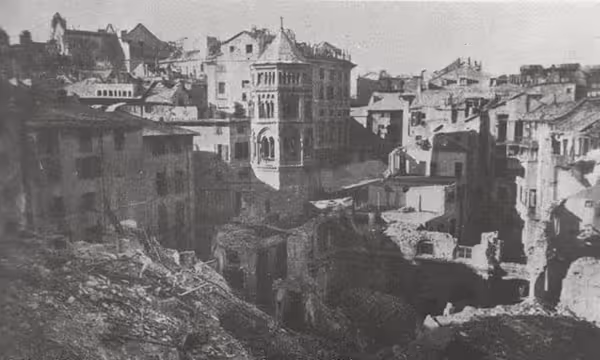
When to go: San Donato is generally open daily around church hours; the Giardini Luzzati are an open public square, at their liveliest in the early evening and a perfect place for a drink.
Sa Pesta, where you can still taste medieval Genoa from a wood-fired oven.
Halfway up the climb toward Sarzano, on Via dei Giustiniani, a marble counter and the glow of a wood-fired oven mark one of the last sciamadde in the city – the old Genoese fried-food shops that were the original street food long before anyone used the term. Sa Pesta has been here since the early 1800s, and little has changed: the oven still turns out farinata, the thin, golden chickpea pancake documented in Genoa since the 15th century, alongside torte di verdura, onion and rice pies, stuffed vegetables and *polpettone*, many bound with the local prescinseua curd and baked slowly. Order a wedge of farinata to eat standing at the counter, or sit down for a plate of the day’s torte – either way you are eating almost exactly what Genoese dockworkers and sailors ate centuries ago. It is cheap, unpretentious and gloriously authentic, the kind of place that has outlasted every food trend because it never once chased one.
When to go: lunch is the safe bet (it’s a sit-down osteria as well as a takeaway counter). Like most family-run sciamadde it closes one day a week, so check the current days.*
Piazza di Sarzano, the oldest public square of Genoa – and the hidden triangular cloister beside it.
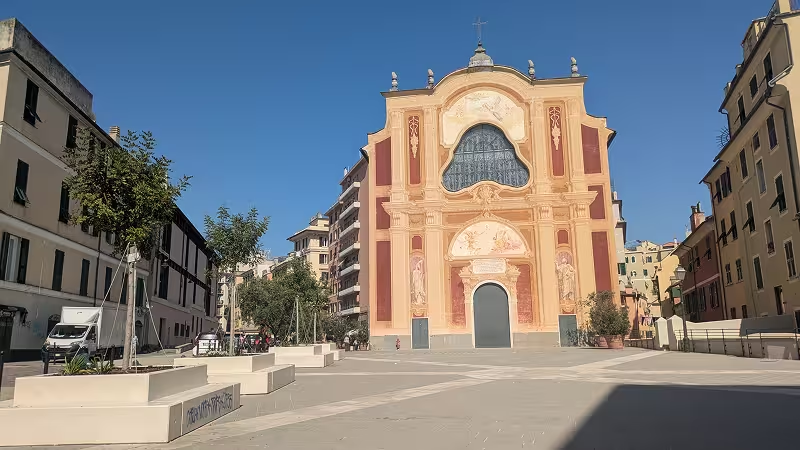
Where the caruggi finally exhale, the ground opens into Piazza di Sarzano – long, sloping and luminous, the oldest public square in Genoa. A communal decree of 1145 declared it open to the people, and for centuries it was the city’s great outdoor stage: knights jousted here on horseback, rope-makers stretched the cordage for the galleys that built Genoa’s fortunes, and the hooded brotherhoods of the Casaccie filed through in procession. For a long time it was the only true square inside the ancient ninth-century walls. At its centre stands a small hexagonal temple ringed with columns, a 16th-century cap over the great cisterns that once watered the city. Look up: crowning the dome is a two-faced bust of Janus, the double-gazing god who – by one well-loved legend – gave Genoa its name, from Arx Jani, the fortress of Janus.
Sarzano hides one more secret in plain sight. Tucked against the square, behind the striped facade of the former convent of Sant’Agostino, lies the only triangular cloister in Genoa – a slender wedge of black-and-white banded columns built in 1260, now part of the city’s sculpture museum. Most people cross Sarzano without ever suspecting it is there.
When to go: the square is always open; the triangular cloister keeps museum hours (generally Tuesday–Sunday), and entry to the cloister itself is free.
Piazza di Campopisano and the ghosts of Pisan prisoners.
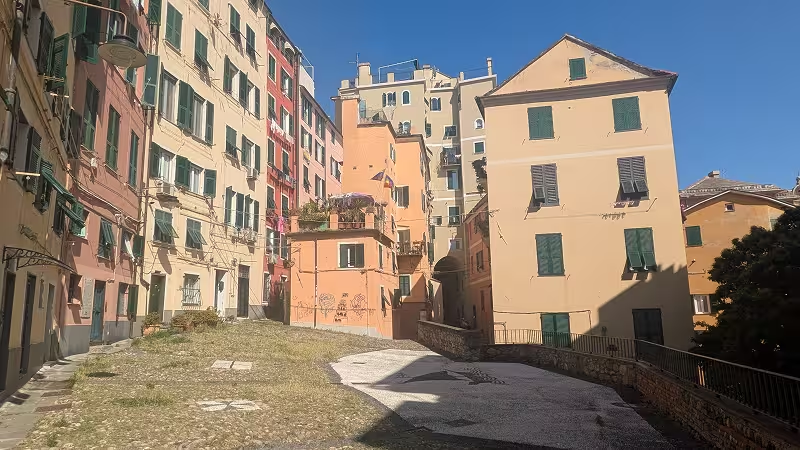
A few steps downhill from Sarzano, a low arch delivers you into Campopisano, one of the most quietly beautiful corners in the whole old city – and one of the most haunted. Today it is a tiny, irregular square of perhaps two hundred square metres, hemmed in by tall terraced houses painted in faded Ligurian pastels, its pavement a carpet of black-and-white river pebbles. Its serenity hides a grim history. After the Genoese fleet annihilated Pisa at the Battle of Meloria in 1284, thousands of Pisan prisoners were herded into this field, then still just outside the city walls. So many died here of hunger and hardship – and were buried where they fell – that the place took the name it still carries: the Pisan Field. Genoa held so many captives that a bitter proverb was born: “If you want to see Pisa, go to Genoa.” Locals will tell you that on stormy nights you can still hear the prisoners’ laments rising between the houses. Come in the late afternoon, when the light is soft and the square is empty, and it is hard not to feel the weight of the story.
When to go: an open square, always accessible – late afternoon is the most atmospheric, and the quietest.
Walk 3 — Toward Prè.
A short hop across to the old sailors’ quarter behind the harbour, near Principe station – two gems that show the working, seafaring side of medieval Genoa.
I Truogoli di Santa Brigida, the communal washhouses where Genoa did its laundry – and its gossip.
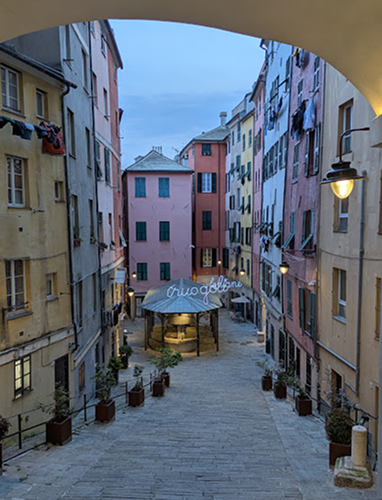
In the tangle of lanes between Via Balbi and the old sailors’ quarter of Prè, a narrow alley opens onto a sight that stops you short: a sunlit courtyard of houses painted in vivid yellow and red and, at its centre, sheltered under an iron canopy, a row of stone wash-basins. These are the Truogoli di Santa Brigida, among the last survivors of the communal washhouses that once served every neighbourhood in Genoa.
Built around 1656 with the backing of the powerful Balbi family and fed by the now-buried Santa Brigida stream, the troughs were for three centuries the social heart of the district – the place where the women of the quarter scrubbed their laundry, traded news and kept the life of the street going. They were still in daily use within living memory. Restored in the 1980s, the basins survive intact beneath their canopy, and the square remains one of the most photogenic and least visited pockets of the old city – a small, intimate monument not to a saint or a doge, but to ordinary Genoese life.
When to go: an open square, always accessible; best in the morning, when the sun fills the courtyard.
The Commenda di Prè, a double church built for crusaders and pilgrims
Near the old harbour and the bustle of Via Prè stands one of the most remarkable medieval buildings in Genoa — and one of the strangest. The Commenda di San Giovanni di Prè was founded in 1180 by the Knights Hospitaller, the warrior-monks who would become the Knights of Malta, as a hospice for the knights, pilgrims and merchants setting off for the Holy Land at the height of the Crusades. Travellers were fed and bedded in the great columned hall, and the sick were tended in what was effectively a medieval hospital. But its real marvel is the church — or rather, two churches, stacked one above the other. The lower church, with three low naves, was for the pilgrims and the poor; the upper church, lighter and grander, was reserved for the knights. It is a rare piece of architecture that builds social hierarchy directly into stone, one congregation literally above the other. Today the complex is a museum and theatre, but stand in the lower church, under those squat columns worn smooth by eight centuries of hands, and the whole medieval traffic of the Mediterranean seems to pass through the room.
When to go: open as the Museoteatro della Commenda, Tuesday–Sunday (closed Monday), roughly 10:00–17:00 on weekdays and 10:00–19:00 at weekends; admission around €10.