
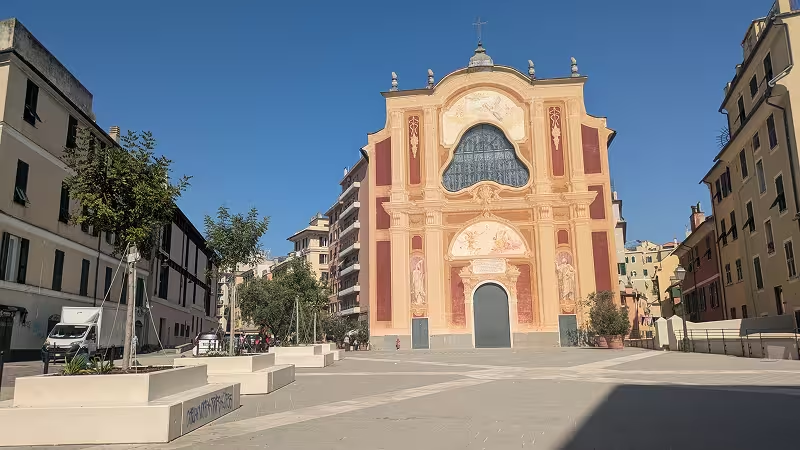
Piazza di Sarzano is the oldest public square in Genoa and one of the most atmospheric corners of its historic centre. Perched at the highest point of the old town, it opens – long, wide and sun-drenched – out of the dark tangle of caruggi that surrounds it. For nearly nine centuries this was a beating heart of the Republic: parliament, tournament ground, marketplace, and the stage for more than one violent legend. Today it’s a quiet, university-fringed square that most tourists walk straight past – which is exactly why it rewards the ones who don’t, and why it’s one of the more unexpected things to do in Genoa I point people to. Ringing it you’ll find a bombed church turned university auditorium, a jewel-box oratory, a Janus-crowned well, and one of Italy’s finest sculpture museums.
One of the oldest squares in Genoa.
Local legend traces the square’s name to the Latin Arx Jani, the “Fortress of Janus” – the two-faced Roman god of beginnings, who supposedly landed at the cove below the hill and founded Genoa on this very spot. Linguists prefer a less mythical origin, likely the pre-Indo-European root sar, a rushing hill stream. But the dark, double-faced myth of Janus is baked into Sarzano’s identity, and you’ll meet his gaze again before you leave.
For centuries, medieval Genoa’s only real gathering ground was the cramped parvise in front of San Lorenzo Cathedral. That changed by a city decree of 1145, which designated Sarzano as a fully public space. As the only large open ground inside the early medieval walls, it quickly became the essential – and often chaotic – heart of the Republic. It served as an open-air parliament: in 1311, a vast crowd gathered here to take the fateful decision to hand the city to Emperor Henry VII. On other days it was a tournament ground for brutal jousts and military drills, and a marketplace ruled by shouting rope-makers and merchants.
Blood on the cobblestones.
Beneath the chivalry lay a darker reputation. Old travellers’ accounts feared Sarzano as a flashpoint for vicious brawls and lethal score-settling. The most notorious came in 1640, when Pellegro Piola — a brilliant young Genoese painter, elder brother of the more famous Domenico — was stabbed to death here in a night-time knife fight, quite possibly set up by rival painters jealous of his talent. His death sealed the square’s legacy as a place where beauty and sudden violence shared the same stones.
The monuments around the square.
You can take in Sarzano in fifteen minutes, or a few hours if you visit its monuments. Here’s what rings the square, and why each is worth a look.
San Salvatore – the church that became a lecture hall.
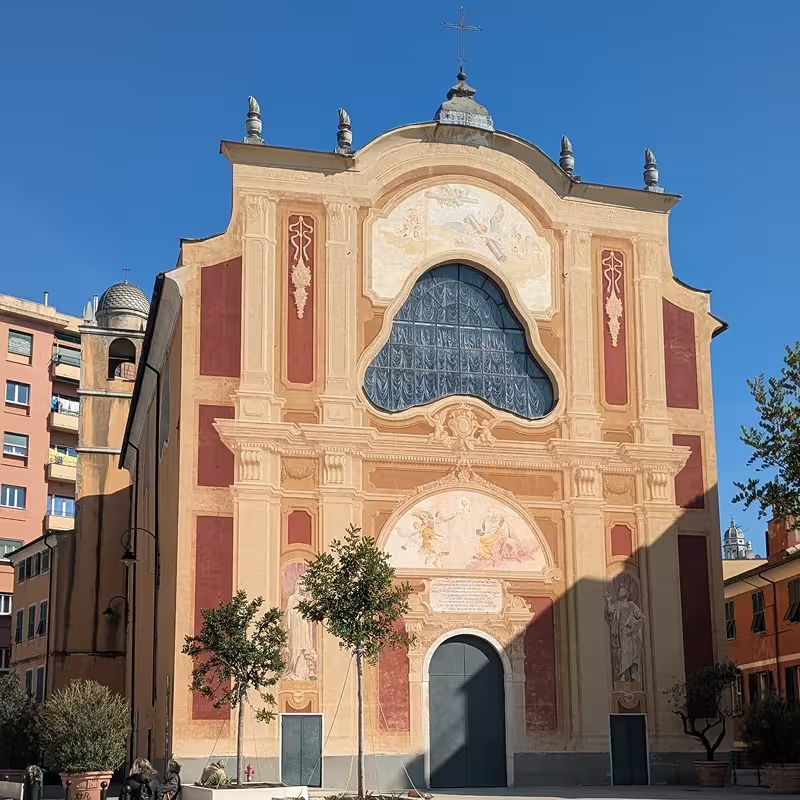
At the southern edge stands the former church of San Salvatore, founded in 1141 and rebuilt as a single soaring Baroque hall in 1653.
Bombed to a roofless shell in the Second World War, it was rescued in the 1990s in one of Genoa’s boldest acts of adaptive reuse: a modern auditorium was slotted inside the ancient stone skeleton.
It now serves as the Aula Magna of the University of Genoa’s Faculty of Architecture – and still hosts concerts and conferences.
Look up at the façade for the trompe-l’œil frescoes, flat paint conjuring architecture that was never built.
Oratorio di Sant’Antonio Abate alla Marina.
Just downhill, reached by the stepped Vico sotto le Murette, this oratory was built in the early 1600s as the headquarters of one of Genoa’s casacce — the wealthy lay brotherhoods that ran the city’s processions and charity. Behind a plain façade hides a Rococo interior dense with stuccowork, a vaulted fresco cycle on the life of Saint Anthony, and a young Gioacchino Assereto’s unsettling Saint Anthony Surrounded by Devils. Its real treasures are the processional crucifixes – above all the Cristo Moro (“Black Christ”), carved from dark jujube wood by Domenico Bissoni in 1639, alongside work by the great Baroque carver Anton Maria Maragliano. When Allied bombs gutted San Salvatore, this little oratory absorbed its parish, and it remains the spiritual heart of the neighbourhood today.
Il Pozzo di Giano — Janus’s Well
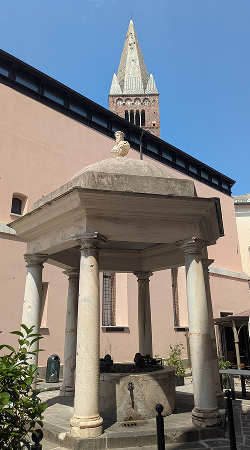
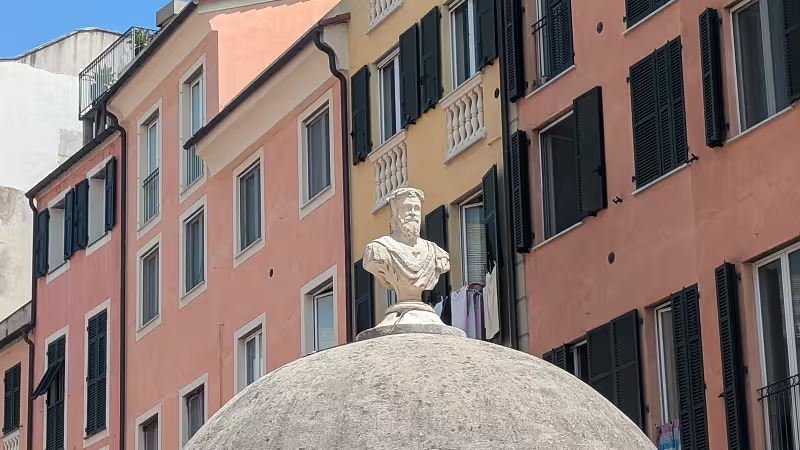
In the open square, a small hexagonal tempietto caps the mouth of a vast 16th-century cistern that once supplied water to the whole quarter. The well itself dates to 1583; the elegant domed canopy was added in the early 1600s, usually attributed to the architect Bartolomeo Bianco. Lean over and you can sense the cistern below — then look up. Crowning the dome is a blind, two-faced bust of Janus, the god of the founding legend, gazing out over the square that may carry his name.
The Museum of Sant’Agostino
On the north side rises the deconsecrated 13th-century convent of Sant’Agostino, its Gothic church begun by Augustinian friars in 1260. Heavily bombed in the war, it was masterfully restored in the 1980s by the architects Franco Albini and Franca Helg, and now houses the Museum of Sant’Agostino, Liguria’s great collection of sculpture and stone fragments salvaged from demolished churches. Among them is the funerary monument of Margaret of Brabant — wife of the very Emperor Henry VII to whom this square swore allegiance in 1311 — carved by Giovanni Pisano. It’s the one monument here you can step inside and visit as a proper museum.
The convent of San Silvestro
On the eastern side, the modern university buildings fold directly into the ruins of the 15th-century convent of San Silvestro – old and new stone grown into one another. It’s a fitting image for a square where every century is still visible at once.
Visiting Piazza di Sarzano
Sarzano sits at the top of Genoa’s old town, a short, steep climb from the Cathedral of San Lorenzo or the Porto Antico. The easiest way up is the metro: the Sarzano/Sant’Agostino station opens almost onto the square. Pair it with a wander through the surrounding caruggi and the climb to nearby viewpoints, and it makes an ideal first stop for anyone who wants to understand how Genoa grew from a hilltop fortress into a maritime superpower.
Quiet, photogenic and overlooked, Sarzano is the kind of place Genoa keeps for the curious – come early, look up, and let the square tell you its story.
Planning your visit? See Is Genoa worth visiting? and our guide to the best viewpoints in Genoa, or explore more of the Heritage & Art of the Superba.