
Perched on the hill that gave Genoa its first foothold, Santa Maria di Castello is one of the oldest churches in the city — and one of the most rewarding to visit. Tucked into the medieval fabric of the centro storico, it repays the effort of finding it with Romanesque architecture, Renaissance frescoes, and nearly a thousand years of uninterrupted history packed into a single building.
Church address.
Salita di Santa Maria di Castello, 15
Opening times
Everyday 10 am to 1 pm and 3 to 6 pm.
Best time for sun lighting
Afternoon
Admission
Free (donations welcome)
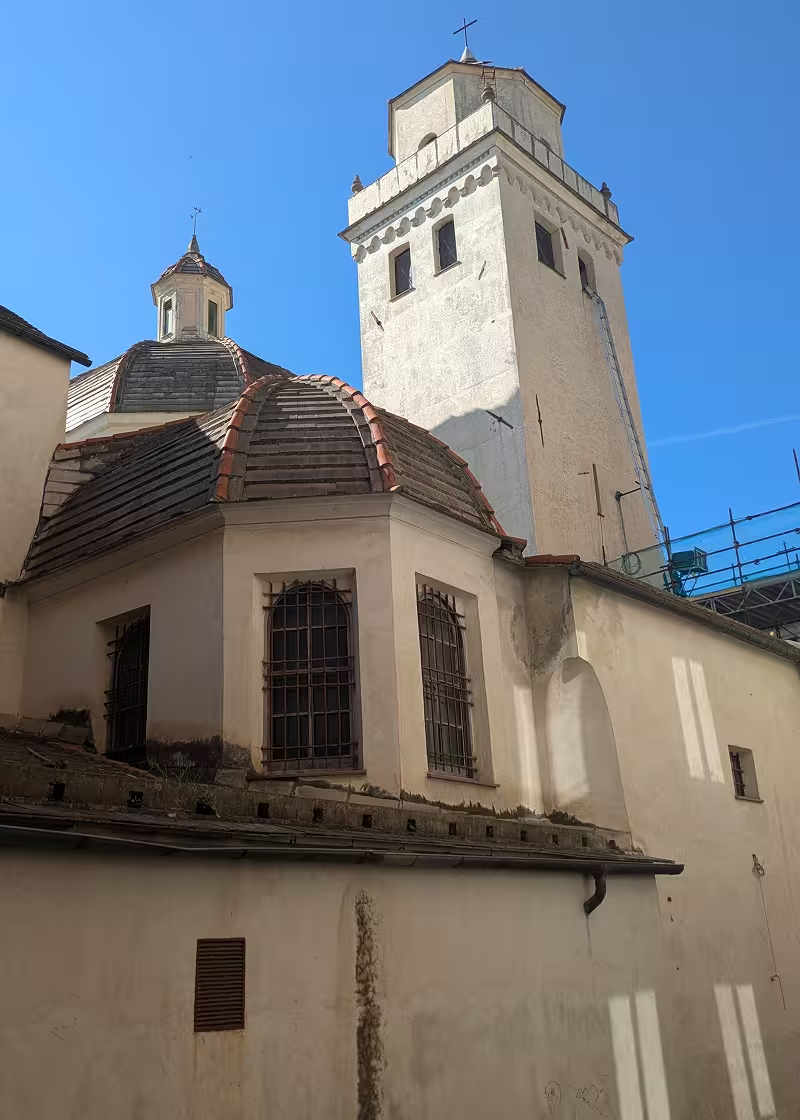
Why it’s worth the climb
Santa Maria di Castello rewards slow looking. Come in the afternoon, when light reaches the cloister, and give yourself time to move from the Roman columns of the nave to the Renaissance frescoes upstairs. Few places in Genoa let you read the city’s whole story – Roman, medieval, Renaissance – without leaving the building.
The history of Santa Maria di Castello
The hill of Castello was Genoa’s first fortified settlement – occupied before the Romans, reinforced under Byzantine rule, and home to a bishop’s fortified palace by the ninth century. This, quite literally, is where Genoa began.
According to tradition, the first church dedicated to the Virgin Mary was raised here in 658 by the Lombard king Aripert I, though the earliest documented evidence dates only to the eleventh century. The building you see today is a three-nave Romanesque basilica with a transept and three apses, built in the first quarter of the twelfth century by the Antelami – a guild of master builders from Lombardy who held a near-monopoly on Genoese church architecture at the time. The basilica was consecrated in 1237 by Gerold of Lausanne, the Latin Patriarch of Jerusalem.
The Antelami’s trademark was the reuse of Roman material. The granite columns and Corinthian capitals lining the nave date from the third century AD, and the main portal’s lintel is a Roman frame carved with leaves and griffins.
A turning point came in 1441, when a papal bull of Eugenius IV entrusted the complex to the Dominican Order. The friars expanded the convent, added new cloisters, and – with the backing of the Grimaldi family – turned Santa Maria di Castello into a hub of humanist culture and a gathering place for Genoa’s intellectual elite. The first cloister, built between 1453 and 1462, still carries its celebrated frescoes, among them the luminous Annunciation painted in 1451 by Giusto d’Alemagna (Justus of Ravensburg). Over the following century, Genoa’s noble families filled the side chapels with commissions from the leading painters and sculptors of the Genoese school.
The Dominicans stayed for nearly six centuries, leaving in 2015. The church is now cared for by the Society of African Missions — though you would barely know it had changed hands. The stones look much as they always have.
What to see inside
For a church of its size, Santa Maria di Castello holds a remarkable density of things worth lingering over. Give yourself time — the rewards are in the details.
Start by looking up. The nave itself is the oldest thing here: granite columns and Corinthian capitals salvaged from third-century Roman buildings, carrying twelfth-century arches. It is a lesson in how medieval Genoa built itself, quite literally, out of the city that came before.
A reused Quranic inscription. Among the spoils built into the church is a marble fragment carved with a Kufic Arabic inscription bearing verses from the Quran, dated to the late tenth century — a quiet trace of the trade and conflict that bound medieval Genoa to the wider Mediterranean.
Mazone’s polyptych of the Annunciation. In one of the side chapels hangs a gilded Gothic polyptych painted around 1469 by Giovanni Mazone, with an Annunciation at its centre, saints to either side, a Calvary above, and small Gospel scenes along the base – one of the finest fifteenth-century altarpieces still in the church.
The Canevari monument. The vast funerary monument of the physician and bibliophile Demetrio Canevari (1559–1625), personal doctor to Pope Urban VIII, was carved by Tommaso Orsolino between 1626 and 1627. Its strikingly naturalistic portrait marks one of the earliest echoes of Roman Baroque sculpture in Liguria.
Baroque chapels. Over the seventeenth century Genoa’s noble families packed the side chapels with paintings by the leading names of the local school – Lazzaro Tavarone, Bernardo Castello, Andrea Ansaldo, Orazio De Ferrari and Giovanni Andrea Carlone among them. It adds up to a compact gallery of Genoese Baroque, all in situ.
The Fregoso Chapel
The Fregoso were one of the most powerful families in Genoa, and they turned Santa Maria di Castello into a private pantheon. Their chapel – also known as the Chapel of the Crucifixion – holds the tombs of several family members who rose to become doge of the Republic.
Among them is Giacomo (Campo)Fregoso, doge in 1390–1391 and son of Domenico di Campofregoso, the fifth doge, whose own tomb at Santa Marta has since vanished. Giacomo’s survives: a sculpted marble sarcophagus showing him as a recumbent effigy in the robes of his office – one of the very few fourteenth-century ducal monuments still standing in situ in Genoa.
The chapel also preserves the tomb of Tommaso Fregoso (doge 1415–1421 and again 1436–1442) and the sarcophagus of Battista Fregoso (doge 1478–1483), a humanist ruler better remembered today for the book of historical anecdotes he wrote after losing power. Together they make the chapel a rare place to stand among the surviving monuments of medieval Genoa’s rulers – most of which are long gone.
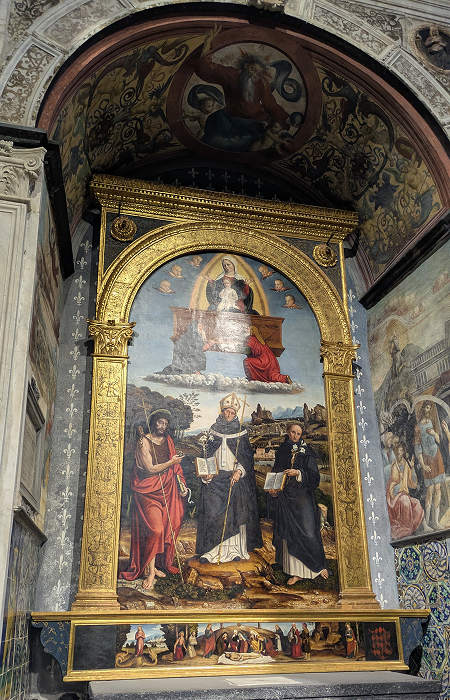
Painting of Pier Francisco Sacchi, Madona Odigitria with Saints 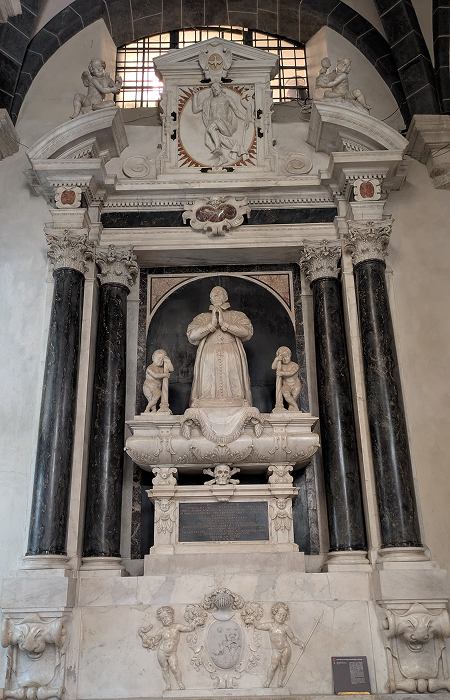
Tomb of Demetrio Canevari
The complex: cloisters and museum
Santa Maria di Castello is not just a church but a monumental complex — the former Dominican convent that grew up around it from the fifteenth century onward. Plan to spend time beyond the nave; the cloisters and museum are where much of the magic is.
The first cloister and the Annunciation. Built between 1453 and 1462, the first cloister is the heart of the complex. Its frescoed upper loggia holds the work most visitors come for: the Annunciation painted in 1451 by Giusto da Ravensburg (Giusto d’Alemagna), a jewel-like Northern Renaissance masterpiece finished with the precision of a miniaturist and often read as a forerunner of the style of Dürer. Sponsored by the Grimaldi, it is one of the most important fifteenth-century frescoes in the city.
The second cloister and the Grimaldi Room. Beyond it lies a second cloister and, in the rooms of the old convent, the former Dominican library — now known as the Grimaldi Room — which preserves the church’s venerated wooden Crucifix, long the focus of a popular Genoese devotion.
The museum. Opened in 1959 and reorganised in 2001, the museum occupies twelve rooms of the convent. It gathers archaeological finds tracing the city’s history from the second century to the late Middle Ages, alongside marbles, reliquaries, vestments, illuminated manuscripts and votive offerings. Among its highlights are a fourteenth-century Madonna and Child by the so-called Master of Santa Maria di Castello, another by Barnaba da Modena, a marble Madonna attributed to Domenico Gagini, and an unexpected collection of nineteenth- and twentieth-century Russian icons donated by Enrico di Rovasenda. Together the cloisters and museum turn a church visit into a walk through eight centuries of Genoese art and faith.
Main artists represented at Santa Maria di Castello.
Before you move on
Santa Maria di Castello sits on the Castello hill, the oldest corner of the centro storico and one of the most atmospheric to wander. Don’t rush off the moment you step out: the Torre degli Embriaci, the best-preserved medieval tower in Genoa, rises just above the church, and a few minutes on foot bring you to Piazza di Sarzano and the monumental complex of Sant’Agostino. Linger here a while – this single hillside holds more of old Genoa than almost anywhere else in the city, and it’s one of the first corners we’d point you to in our guide to the best things to do in Genoa.