
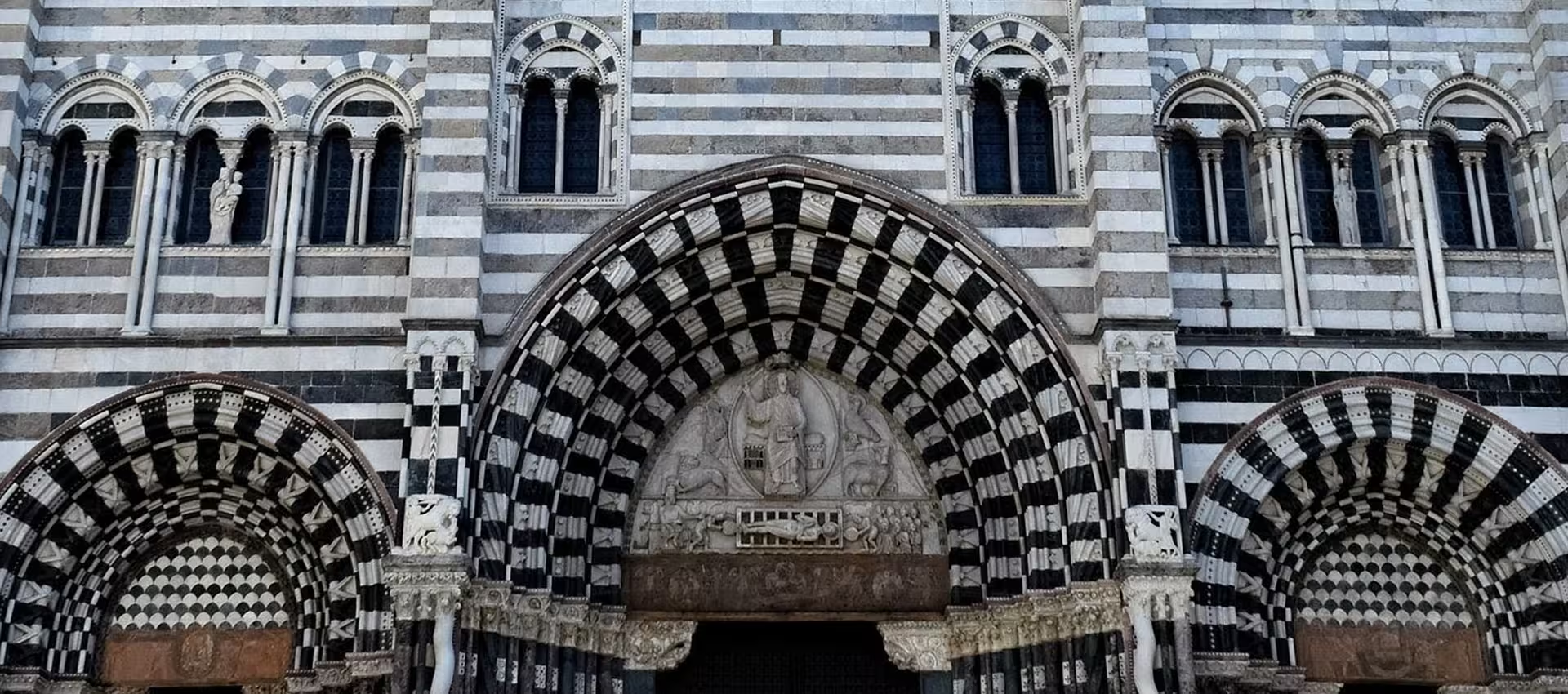
San Lorenzo Cathedral (Cattedrale di San Lorenzo) is the most emblematic monument of Genoa and the spiritual heart of its old town. Its black-and-white striped marble facade is the most monumental piece of medieval architecture in the city centre, and the Duomo is a must-see on any visit to Genoa. This guide starts with everything you need for a quick visit, then goes deep into the cathedral’s thousand-year story and the remarkable sculptures hidden in plain sight across its facade.
Cathedral San Lorenzo –
Quick facts
Plan: basilica with three naves, a transept, and a triple apse
Consecrated: choir and altar by Pope Gelasius II in 1118
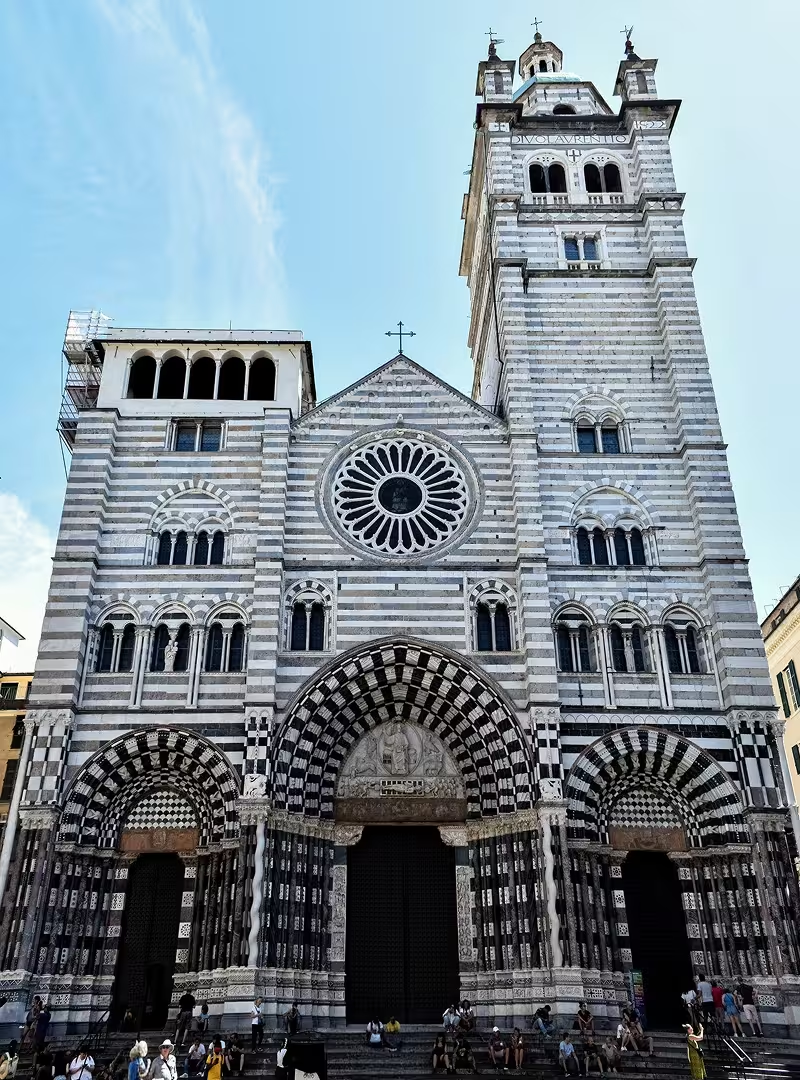
Façade: white-and-black striped marble, three French-inspired portals, rose window completed 1476
Bell tower (south/right): finished 1522, about 60 m high, with 7 bells
Left tower: never completed; crowned with a loggia in 1477
Approx. footprint: roughly 75 m long × 25 m wide
Visiting – the essentials
Where
Piazza San Lorenzo, Genoa old town, halfway along Via San Lorenzo
Entry
Cathedral: free. Treasure Museum (Museo del Tesoro): around €5, separate ticket bought inside
Opening hours
Roughly daily 8:00–12:00 and 15:00–19:00; closed to visitors over the midday break. Check current hours before you go
Treasure Museum & Tower
Usually open Mon and Wed–Sat (mornings & afternoons) and Sun afternoons; closed Tuesday
Dress code
Shoulders and knees covered; it is an active place of worship
Getting there
Metro to De Ferrari or San Giorgio, then a short walk; fully walkable from the port and Piazza De Ferrari
Time needed
15–20 min for the church; add 30–45 min for the Treasure Museum
What to see in 20 minutes
Even a short stop rewards you. These are the highlights most visitors come for:
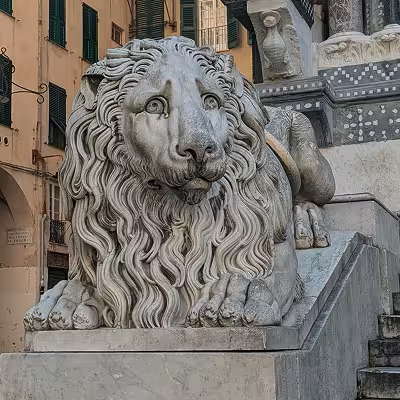
- The striped facade. Bands of white marble and dark stone create the Genoese striped look, a medieval symbol of prestige. Two marble lions guard the steps.
- The Holy Grail. In the Treasure Museum beneath the church, the Sacro Catino — a green hexagonal dish — was long venerated as the cup of the Last Supper. It is the single most famous object in the cathedral.
- The Chapel of St John the Baptist. In the left aisle, this richly decorated Renaissance chapel is tied to the relics of the city’s patron saint.
- The unexploded shell. In the right aisle sits a naval shell fired by the British fleet in 1941 that crashed through the roof but never detonated, kept as a reminder of the city’s wartime survival (the piece on show is a replica).
- The interior. Fourteenth-century frescoes, soaring Gothic naves, and, when open, a climb toward the dome for a view over the rooftops of the old town.
Planning your visit
Aim for mid-morning or late afternoon, since the cathedral closes to sightseeing over the long midday break. The main church is free, so you can step in even with little time; buy a Treasure Museum ticket inside if you want to see the Sacro Catino and the cathedral’s gold and silver reliquaries. The cathedral makes a natural first stop on a one-day walking tour of Genoa, within a few minutes of Piazza De Ferrari, the Doge’s Palace, and the medieval caruggi (alleys) of the old town.
Hours and museum days change seasonally, so confirm them on the official Visit Genoa site before your trip.
The deeper story: a thousand years of building
The cathedral you see today is the product of fifteen centuries of refuge, ambition, fire, and reinvention. For travellers who want to read the building rather than just photograph it, here is how it came to be.
From the refuge of the Bishop of Milan to the Duomo of Genoa
Archaeological excavations carried out in 1966 proved that a first basilica dedicated to Saint Lawrence stood on this site in the 6th century. Scholars identify it as the sanctuary used by the Bishop of Milan, who had fled his own city in 569 with a group of wealthy citizens, seeking refuge in Genoa to escape the Lombard invasion of Byzantine northern Italy. A baptistery formed part of this early complex. In the 9th century, during the Carolingian era, a defensive wall was raised to protect the core of Genoa, safely enclosing the church.
Genoa’s cathedral at that time was dedicated to the Twelve Apostles and stood in the upper town (the burgus), which sat exposed outside the city walls. That vulnerability is likely why the basilica of Saint Lawrence was chosen in 878 to house the relics of Saint Romulus, an early bishop of Genoa. As its importance grew between 876 and 952, San Lorenzo gradually supplanted the city’s original cathedral.
From Romanesque church to Gothic masterpiece
The vast basilica of the Bishop of Milan, with its baptistery, was probably first renovated in the second half of the 11th century — a phase still attested by fragments of stonework and sculpture reused, somewhat haphazardly, in the present facade. At the start of the 12th century, as Genoa’s power surged across the Western Mediterranean, the city resolved to rebuild the church entirely in the Romanesque style. The new building was not much larger than its predecessor, but it was conceived as a grand symbol of the political autonomy of the newly self-governing city. In 1118, Pope Gelasius II consecrated the choir and altar in person. The minor apses were finished around 1130, and by 1142 the north portal was already in use.
The decision to give the southern portal of San Gottardo a projecting porch forced a sudden change to the original plans, raising the lateral walls higher than intended; a bell tower was then added. The immediate result did not convince everyone: sources from the period describe the structure as imperfect and misshapen. Today only the choir, part of the main apse, the two flanks with their lateral portals, the front of the false transept, and a portion of the clerestory of the central nave survive from this Romanesque phase.
Around 1225 the building was radically transformed into a Gothic masterpiece. The works were led by a Franco-Norman architect and sculptor, working alongside a second French sculptor (known as the Master of the Arch of the Baptist) and collaborators drawn from other cities. They raised a grand facade with two towers, an internal narthex, and vaulted naves: a cathedral modelled directly on those of Northern France, yet infused with a distinctly Mediterranean spirit, seen above all in its striking marble revetment and polychrome inlays. After the first tier of the facade was completed, however, work stopped abruptly for reasons that remain unclear.
Fire, completion, and later life
Disaster struck in 1296, when a severe fire caused extensive damage. The restoration that followed brought the facade to completion between 1297 and 1317. While much of the original Romanesque walling was preserved, most of the nave columns were replaced along with their capitals (except those on the upper half-columns), and the central apse was remodelled.
Two inscriptions, dated 1307 and 1312, still commemorate the completion of the two colonnades, and striking frescoes were painted on the counter-facade by a Greek artist in the same years.
Work on the facade pressed on through the 15th century. The rose window was completed in 1476, and the elegant loggia of the north-east tower was built between 1445 and 1447, though the south tower itself was only finished much later, in 1522. The central apse was restructured between 1516 and 1526.
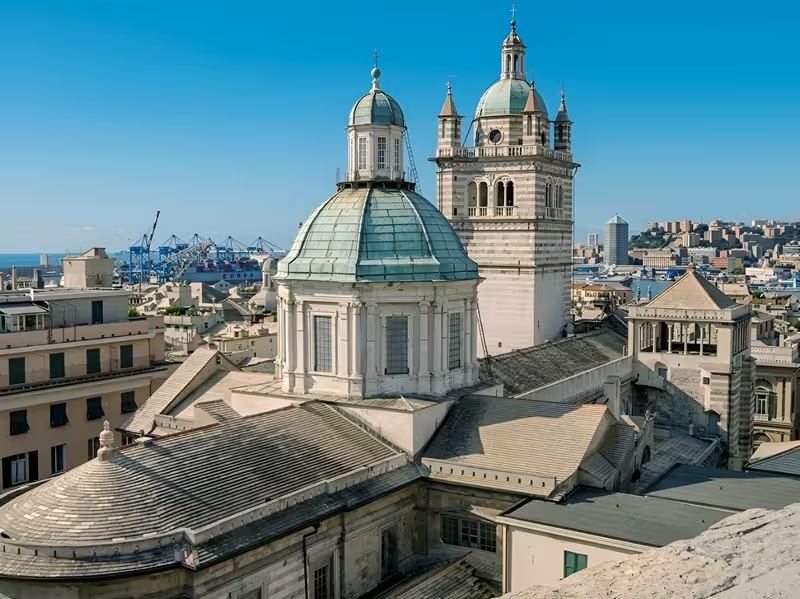
Progress was interrupted again between 1527 and 1530, when the explosion of a powder store in the neighbouring archbishop’s palace severely damaged the roofs. During the repairs the church was crowned with a dome and drum, an ambitious feature that was only partly realised. Centuries later, between 1893 and 1900, a major campaign aimed to restore the cathedral to its medieval appearance, and the facade received further meticulous attention between 1932 and 1933.
Piazza San Lorenzo: how the cathedral got its stage
Through the Middle Ages the cathedral was hemmed in by a dense urban fabric and overlooked only a small open space. Around it stood two archiepiscopal palaces, the chapter house, the rectory, the sacristy, two cloisters, the baptistery and, near the north-east corner, a cemetery. Before the 14th century its parvis was the only true public space in the city, since there was as yet no seat of secular power, and so it hosted public ceremonies and celebrations.
The cathedral stayed woven into the tangle of the caruggi until 1835, when a new street was cut through the centre, opening a wider space along the southern flank: today’s Via San Lorenzo. The present Piazza San Lorenzo was created at the same time by demolishing the buildings that crowded the site. The street level was lowered as well, isolating the cathedral so that it could only be reached by steps, in a piece of stagecraft very much to 19th-century taste and still the way we experience the building today. This turbulent history explains why the original design was never fully carried out: the left tower was never finished and was eventually capped with a loggia, leaving it quite unlike the right tower and giving the cathedral its distinctive asymmetrical silhouette.
Reading the facade: a closer look
The facade of San Lorenzo is an open-air museum. Across its marble and stone, builders set fragments from many centuries, from Roman sarcophagi to Romanesque friezes and Renaissance statues. Here is how to read the three faces most worth lingering over.
The baptistery side and the Portal of San Giovanni
On the cathedral’s left side, facing the small Piazzetta San Giovanni, stands the facade of the baptistery, paleo-Christian in origin but rebuilt in the 15th century. Its portal is crowned by a Baptism of Christ carved by Nicolò da Corte, a sculptor from Cima di Valsolda active in Genoa between about 1530 and 1537. Beside it opens the Portal of San Giovanni, the oldest doorway of the cathedral, dating to 1118–1142. Originally built with a splayed jamb of two steps and a semicircular lunette, it was enriched between 1155 and 1161 with a two-order porch modelled on the portal of San Gottardo.
The architrave is a reused Roman piece, while the supporting lintel is Romanesque, carved with plant motifs. The columns rest on bases with eagles, and the jambs carry lions, a chimera, a fish-siren, and vegetal and geometric interlace, to which was added a Madonna and Child enthroned, dated 1342, a work of Campionese production set to mark the tomb of the Bozzolo family. All the Romanesque sculpture here is of Lombard-Cosmatesque workmanship. Into the two-tone facing of the tower, like the whole stone-and-marble front, builders set eight fragments of sarcophagi from late-Roman and paleo-Christian times, dating from the 2nd to the 4th century, alongside a frieze of a Dionysiac thiasos from the 2nd to 3rd century. Next to the Gothic window, a frieze of dragons, a dove, a lion and an eagle — Lombard-Cosmatesque in style and made during the late 11th-century rebuilding — is likewise reused.
The Gothic facade
The main Gothic facade also gathers sculpture of many dates. The two large lions on the steps belong to the creation of the square: they are the work of Carlo Rubatto, around 1845.
Older by far are the works of an anonymous master close to Benedetto Antelami, who carved the stylophore (column-bearing) lions on either side of the facade, the corbels that support them, the bases set above them, and the two slabs with Venationes (scenes of animals fighting). Of great refinement, they date from the 12th and 13th centuries and may come from a portal prepared for the Romanesque facade.
Above the side door, the statue-column of the Madonna and Child was carved around 1230 by a follower of the French sculptor of the lunette, while the Saint John the Baptist beside it is of the 15th century, and two further fronts of Roman sarcophagi are set nearby. The rose window was reframed in 1869, together with its glass, but the symbols of the Evangelists and the Eucharistic Lamb on the upper part are 15th-century work. The lion-head gargoyle, also reused, dates to the late 11th century; the original is kept in the sacristy.
The south tower side
On the side of the south tower, look for a large splayed window, identical to the one in the north tower and restored at the end of the 19th century, together with eight frontal slabs from late-Roman sarcophagi and two reused early-Romanesque slabs of the 11th century. Various fragments recovered when houses in the area were demolished were arranged here in 1873: a Saint George with two saints (early 16th century), a Madonna of the 17th century, and two fragments perhaps from Gagini-style portals (15th–16th century).
Inside the cathedral: what to see and how to read it
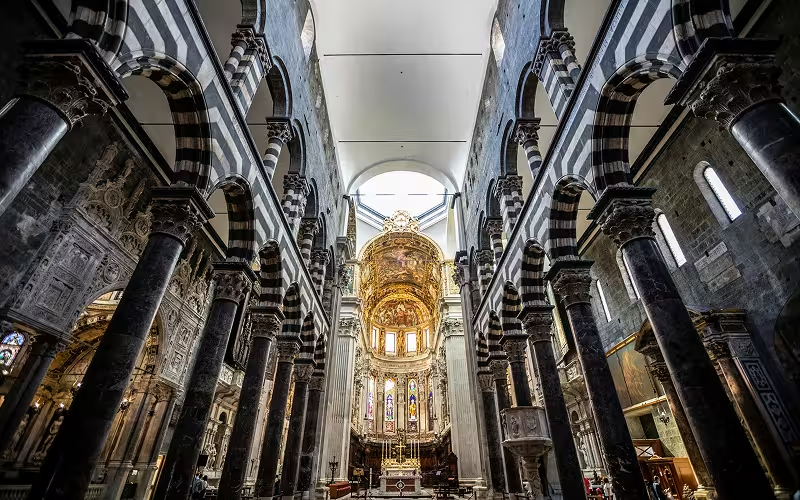
The interior is more sober than the dazzling facade, and that restraint is the point: a tall, three-aisled Gothic hall of grey-and-white stone, lit through a clerestory and lined with reused antique columns. But the side chapels and the presbytery hold some of the finest sculpture and fresco in Liguria. Here is what to look for, aisle by aisle.
The nave and the wartime shell
Step in and let your eye run down the three naves to the raised presbytery. The alternating columns and the marble banding carried inside from the facade give the space its rhythm. In the right aisle, mounted against a pillar, is the cathedral’s most surprising relic of modern history: a British naval shell that crashed through the roof on 9 February 1941 during the bombardment of Genoa and failed to explode. It is kept, with a plaque, as a memorial to the city’s narrow escape (the object on display is a faithful copy).
The Byzantine frescoes over the door
Turn back toward the entrance and look up: the inside of the facade carries something rare in an Italian cathedral. Painted shortly after the 1296 fire, around 1307–1312, these frescoes are the work of an anonymous master trained in the Greek, Constantinopolitan tradition — a painter documented in the city as Marco il Greco. In the great lunette over the main portal they show a Last Judgment and the Glorification of the Virgin, with a Christ in Majesty (a Deesis) in the inner narthex. Fully Byzantine in style yet set in a Gothic cathedral, they are among the very few surviving Byzantine-manner monumental paintings in the Latin West — a direct echo of Genoa’s deep trading ties with the Eastern Mediterranean.
Read more about the Byzantine Treasures preserved in Genoa on Byzantine World.
The Fieschi tomb in the De Marini Chapel
In the first chapel of the left aisle — the De Marini Chapel of the Annunciation, a cool marble room of 1452 — rests one of the most beautiful funerary monuments still in its place in the cathedral: the tomb of Cardinal Giorgio Fieschi, archbishop of Genoa, who died in 1461. It was carved by Giovanni Gagini, of the same family of sculptors who built the Chapel of St John the Baptist, and it sits poised between two eras — crisp and Renaissance in its marble handling, yet still medieval in its overall design and in the quiet dignity of the recumbent effigy (the gisant). Look too for the chapel’s altarpiece by the Genoese painter Giovanni Battista Paggi, and for the small doors beside the altar that once led into San Giovanni Vecchio, the cathedral’s old baptistery. An even grander Gothic tomb — that of the earlier Cardinal Luca Fieschi (died 1336), the first private monument ever raised inside the cathedral — once stood in the nave; recomposed from 124 scattered fragments, it is now displayed in the adjoining Museo Diocesano, reached through the medieval cloister and well worth pairing with your visit.
The Chapel of Saint John the Baptist: the interior’s masterpiece
In the left aisle opens the Chapel of St John the Baptist (Cappella di San Giovanni Battista), built to house the relics of the city’s patron saint, said to have reached Genoa after the First Crusade.
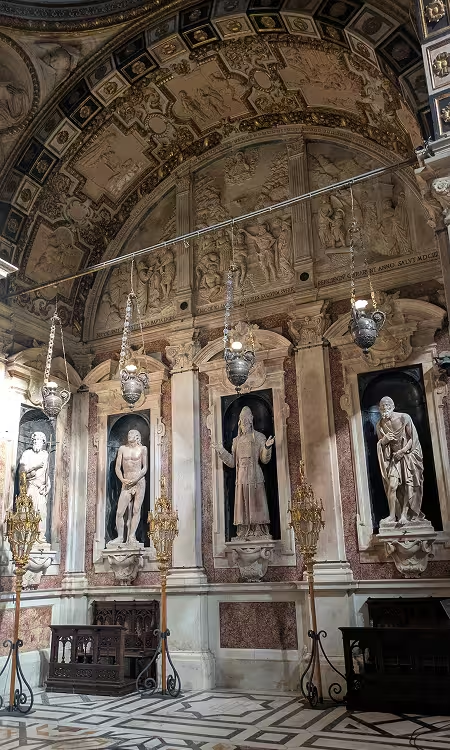
Commissioned by the saint’s confraternity from 1448, it was designed and built between about 1450 and 1460 by Domenico Gagini, a Lombard-Ticino sculptor working in the new Tuscan Renaissance manner, with his nephew Elia Gagini. It is one of the earliest and purest Renaissance interiors in Genoa.
The decoration is a roll-call of Renaissance sculptors. Six life-size marble statues of saints, carved in the last years of the 15th century by the Tuscan master Matteo Civitali, line the walls in quiet contemplation; flanking the altar, in two niches, stand a Madonna and Child and a St John, both by Andrea Sansovino (1503), their gentle contrapposto a textbook of High Renaissance grace. The altar is crowned by a marble baldachin (1530–1532) by Nicolò da Corte and Gian Giacomo Della Porta — the same Nicolò whose Baptism of Christ tops the baptistery portal outside.
Behind it, on a base, sits the 13th-century marble ark (arca) that long held the Baptist’s ashes, carved by one of the French sculptors who worked on the facade portals around 1225 — a direct thread linking the inside of the cathedral to its Gothic front.
By old tradition, women were admitted to this chapel only on the saint’s feast day, a custom recalling the role of Salome in the Baptist’s death.
The presbytery, the apse and Alessi’s dome
The east end was modernised in the 16th century by Galeazzo Alessi, the Perugian architect who gave Genoa so much of its Renaissance face; the elegant Mannerist dome over the crossing is his. Look up in the choir and apse for the late-Mannerist frescoes of Lazzaro Tavarone, painted between 1622 and 1624 amid sumptuous gilded stuccoes: the Martyrdom of St Lawrence spreads across the choir vault, with the Trial of St Lawrence in the apse and St Michael the Archangel on the presbytery vault. Together they turn the sanctuary into a glowing canopy of gold and colour above the high altar.
The Lercari Chapel
At the head of the left aisle, the Lercari Chapel (later 16th century) is a complete Mannerist ensemble frescoed by two of Genoa’s leading painters, Luca Cambiaso and Giovanni Battista Castello, known as il Bergamasco. Their cycle of the life of the Virgin — the Presentation in the Temple, the Betrothal of the Virgin, and a Coronation of the Virgin in the apse — shows Cambiaso’s elongated, energetic figures and casts the Virgin as protector of the city.
Beneath the church: the Treasure Museum
From inside the cathedral, a stair leads down to the Museo del Tesoro (Treasure Museum), an austere underground space carved out by Franco Albini in 1956 and prized today as a small masterpiece of 20th-century museum design. It guards the cathedral’s greatest relics — from the Sacro Catino, long believed to be the Holy Grail, to the jewelled Cross of the Zaccaria and the chalcedony plate of the Baptist. The stories behind them are below, in Secrets and anecdotes. The museum is a separate, ticketed visit and the natural next step after the church above.
Secrets and anecdotes of San Lorenzo
A cathedral built and rebuilt over fifteen centuries collects more than architecture. San Lorenzo hides jokes in its stonework, keeps a relic that turned out not to be what everyone believed, and stands on a city far older than the church itself. Here are the details worth slowing down for.
Legends carved into the facade
Look low on the right-hand portal, the one nearest Via San Lorenzo, and at about eye level you will find a tiny sleeping dog carved into the base of a column. Legend says it belonged to one of the masons working on the facade; when the dog died, its heartbroken owner immortalised it in marble. Genoese lore now claims that whoever spots the dog is destined for true love, while anyone who can’t will stay single. Resist the urge to stroke it for luck, though — the oils from countless hands slowly eat away at the stone.
At the right corner of the facade, above a lion, stands a slender statue-column the locals nicknamed l’Arrotino, the knife-grinder. He is really St John the Evangelist, and the metal rod he holds is no blade but a gnomon: the figure doubled as the city’s public sundial, the cathedral quite literally keeping civic and market time for the square below. Lower down, on the columns of the San Gottardo portal along Via San Lorenzo, run a series of scratches traditionally said to be the marks of crossbow bolts loosed during the street battles between Guelphs and Ghibellines in the 13th century.
Hidden in plain sight
On the third white step of the staircase, someone long ago incised a triplice cinta — three squares nested one inside the other and joined at the corners. The same design turns up across medieval Europe as both a board game and a protective or esoteric symbol, and nobody is quite sure which it was meant to be here. Inside, in the right aisle, hangs the cathedral’s strangest souvenir: the British naval shell that punched through the vault on 9 February 1941 and, against every odds, failed to explode (see the interior section above).
Beneath your feet: a city older than the church
Excavations in 1966, led by the archaeologist Tiziano Mannoni, cut down through the floor and the square and read the ground like a book. They found human use of the site stretching back to the 2nd century BC, a Roman-era pagan cemetery with stone sarcophagi, the first stable Christian burials from the mid-3rd century, and a thick lime-concrete floor dated to around 538 AD — the physical footprint of the early refuge-church used by the Bishop of Milan. The cathedral, in other words, sits on roughly two thousand years of continuous Genoese life.
The treasures below
The single most famous object in Genoa is the Sacro Catino, a green hexagonal dish carried home as crusader booty from the sack of Caesarea in 1101. For centuries it was believed to be carved from a single colossal emerald and, from the 1290s, to be nothing less than the Holy Grail, the vessel of the Last Supper; a Spanish traveller in 1436 reported in all seriousness that the true Grail was kept in Genoa. The illusion ended with Napoleon, who seized it in 1805. When it came back in 1816 it was broken into about ten pieces, one of them lost forever — and the breakage revealed that the “emerald” was in fact green glass, now identified as 9th- or 10th-century Islamic work. Genoa kept venerating it anyway.
Nearby sit two more showpieces. The chalcedony plate is tied by tradition to the severed head of John the Baptist; the museum backlights it so that the pale blue-white stone glows red as the light passes through.
The Cross of the Zaccaria (Croce degli Zaccaria) is a dazzling 13th-century Byzantine reliquary of the True Cross in gilded silver, studded with pearls, emeralds, sapphires, rubies and garnets, named for the Genoese family who gave it to the cathedral in the 15th century. All three are displayed in the underground Treasure Museum, itself worth the ticket as one of the most admired works of modern Italian museum design.
Read more on the Cross of the Zaccharia on Byzantine World.
Before you leave
San Lorenzo rewards both the quick visitor and the slow looker. Step inside for the frescoes and the Holy Grail, then walk back out and spend a few minutes on the steps reading the facade, where a Roman hunting scene, a medieval dragon, and a Renaissance saint share a single wall. From here the rest of the old town is on your doorstep: Piazza De Ferrari and the Doge’s Palace are a two-minute walk, and the caruggi lead down to the Old Port. The cathedral is the right place to begin a day in Genoa, and the easiest way to understand how the city saw itself across a thousand years.