
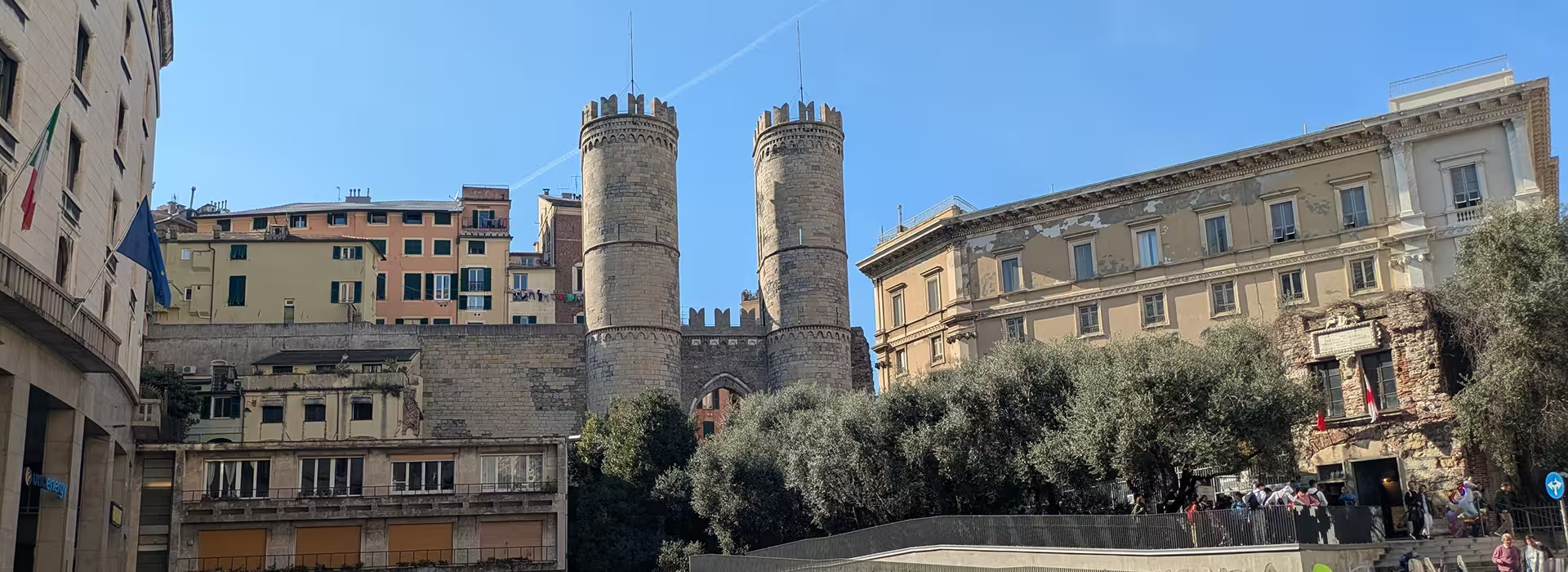
Carved into the inner arch of Porta Soprana, a Latin inscription speaks in the first person, directly to whoever approaches: if you bring peace, you may touch these gates; if you seek war, you will return wrapped in sadness. Eight centuries later, the stone is still there. So is the warning.
The gate – and the walls as a whole – were built in four years. Not by an army of labourers, but by an entire city: nobles and commoners working in shifts, side by side, driven by a single fear. Frederick Barbarossa was coming. What they raised between 1155 and 1159 was not just a fortification. It was a statement. And it worked so well that Genoa ended up naming the walls after the very emperor they were built to stop.
Visiting the Porta Soprana
You can climb the towers of Porta Soprana, entered together with the neighbouring Casa di Colombo (Casa di Colombo + Porta Soprana towers €5 (€3 over-65s, free under 18); combined with the Sant’Agostino Museum €8).
Hours (seasonal): Nov–Mar, Tue–Thu 11:00–15:00, Fri–Sat 11:00–16:00; Apr–May & Sep–Oct, Tue–Sun 11:00–17:00; Jun–Aug, Tue–Sun 11:00–18:00. Closed Mondays.
Where: Via di Porta Soprana, right beside Piazza Dante and a two-minute walk from Piazza di Sarzano.
Time needed: 30–45 minutes, or combine it with Sarzano and the old town for a half-day.
The construction of the city walls: A race against time
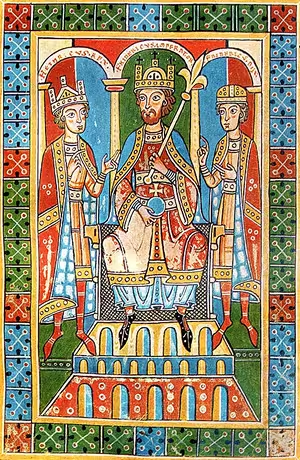
In the 1150s, the Holy Roman Emperor Frederick I, famously known as Barbarossa, marched into northern Italy to reassert imperial dominance over autonomous Italian communes. His main target was Milan, the superpower of northern Italy. In 1154, the emperor started his Italian expeditions. Lacking the strength to assault Milan directly, he laid siege to one of its allies, the small city of Tortona. When the city finally surrendered after two months of vicious blockade, its citizens were expelled and the city razed to the ground, a brutal destruction that sent shockwaves through the region. Barbarossa went to Pavia, where he was crowned king of Italy.
The Genoese were terrified, because they knew that Genoa, rapidly expanding its wealth and maritime trade, was a prime target. The 9th century walls were too small and obsolete for the thriving republic that Genoa had become. Faced with the possibility of an imminent invasion, the entire city mobilized from 1155 onwards to construct defenses. Citizens from every social class, including the nobility, organized themselves into shifts to clear land, carry the material, and raise the stone barrier.
The mobilization was incredibly successful. Within just four years, by 1159, Genoa enclosed a massive area of about 55 hectares with a sturdy stone curtain wall, complete with defensive towers and monumental gates.
Deterrence, then obsolescence: what became of the walls
Interestingly, the Barbarossa Walls never faced a direct, bloody siege by the Emperor’s imperial army. Instead, their utility lay entirely in psychological deterrence and diplomatic leverage. When Barbarossa’s emissaries arrived in Genoa, they saw a fiercely unified population entrenched behind a brand-new, formidable stone fortress. Realising that a siege would be long, costly, and highly uncertain, the Emperor chose diplomacy over war. In exchange for a formal oath of allegiance and a financial tribute, Barbarossa recognised Genoa’s legal autonomy, its right to elect its own consuls, and its vast commercial privileges. The walls successfully achieved their goal without firing a single arrow, allowing Genoa to preserve its maritime empire. Meanwhile, Milan was blockaded between 1158 and 1162, and finally surrendered. The population was expelled, Its fortification were torn down as well as the palaces and towers of its nobility, and the city remained a ghost town for around 5 years. Thanks to their massive mobilisation, Genoa managed to avoid such a grim fate, and the walls ended up bearing the name of the very emperor they were built to keep out.
The main weakness of the Barbarossa Walls was Genoa’s own booming success. By the 14th century, the population had completely outgrown the 12th-century perimeter. Dense neighbourhoods sprouted outside the gates, leaving large parts of the population unprotected.
As military technology advanced – particularly with the introduction of gunpowder and heavy artillery – the thin medieval curtain walls could no longer withstand modern warfare. Genoa gradually swallowed its own history. New, larger ring walls were constructed in subsequent centuries, ultimately culminating in the massive 17th-century Mura Nuove (New Walls). The Barbarossa line was retired from military duty, and its stones were slowly absorbed into the foundations of houses, gardens, and expanding streets.
What to see today: the surviving gates and walls
Despite centuries of urban development, spectacular remnants of the 12th-century shield stand tall in modern Genoa. However, the fact that Porta Soprana and Porta dei Vacca survived at all is a historical miracle. Like the other gates, they were completely swallowed by residential buildings during the 14th and 15th centuries. Houses were literally built on top of the arches, and the towers were modified into private apartments or prisons.
They survived because, by the 19th century, historians and architects acknowledged their immense cultural value. Between 1890 and 1914, famous architect Alfredo d’Andrade led a massive restoration campaign. Workers systematically demolished the houses that had encrusted the gates for 500 years, freeing the medieval stone, restoring the crenellations, and leaving us with the clear views we enjoy today.
Nonetheless, not all the gates were that lucky: two of the secondary ones and the third main gate and were destroyed, the latter only around 60 years ago.
Porta Soprana
Located right next to Piazza di Sarzano and the house traditionally said to be Christopher Columbus’s childhood home, Porta Soprana is the crown jewel of the surviving walls. Its name simply means “the upper gate”: it guarded the eastern approach to the city while its western twin, Porta dei Vacca, was the “lower” one.
Two tall semi-circular towers flank a soaring pointed archway, topped with crenellations. For centuries the gate was buried inside houses — its towers carved up into apartments and even used as a prison – until Alfredo d’Andrade’s restoration freed the medieval stone around 1900.
Today you can climb the towers (see the visiting details above): the chambers and the walkway between them show how the gate was built and open onto a view over the rooftops of the old town. Right beside it sit two more reasons to linger – the Casa di Colombo and the small medieval cloister of Sant’Andrea, moved here when its monastery was demolished.
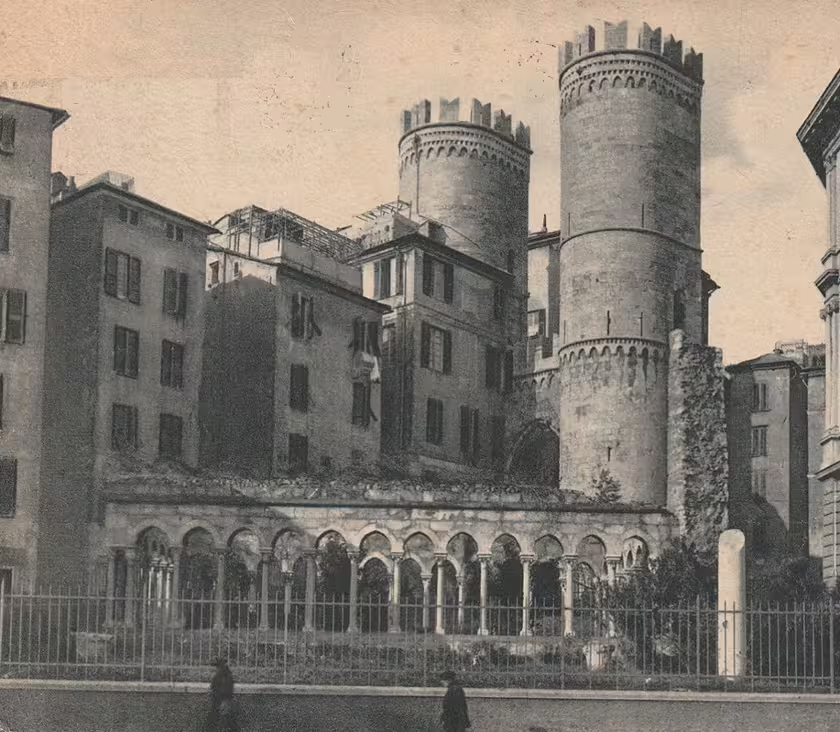
Vintage view of the Porta Soprana hemmed in by later housing 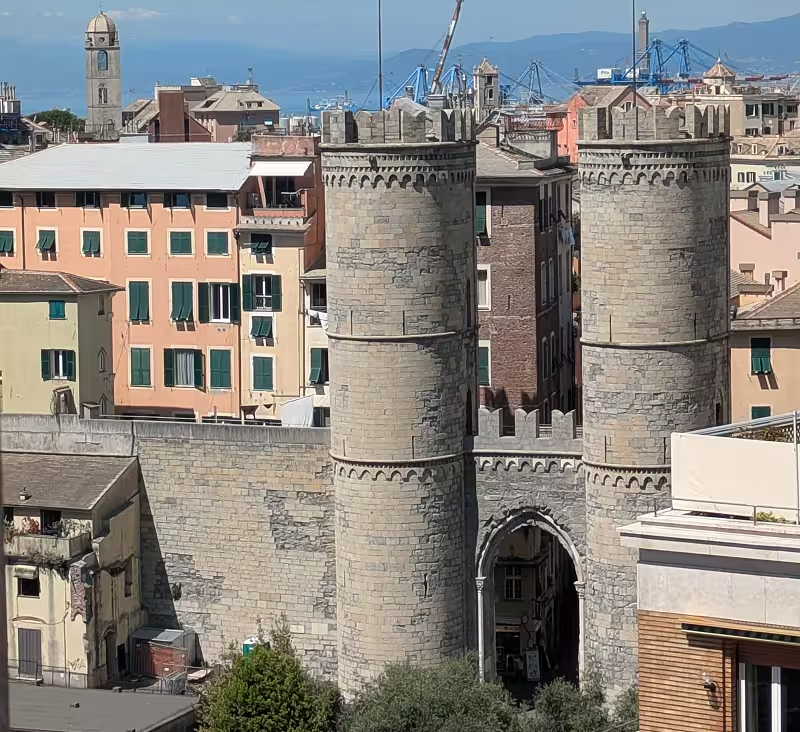
Modern view of the Porta Soprana and the curtain wall of the Barbarossa walls
Porta dei Vacca
Standing at the western edge of the old city near the port, Porta dei Vacca was the main western gateway, opening toward Pré and the coast. It was originally called Porta di Santa Fede, after a nearby church, and nicknamed Porta Sottana — the “lower gate” — in deliberate contrast to Porta Soprana. The odd name “Vacca” (cow) actually comes from a family, the Vacca, who once lived beside it.
Like its eastern twin it has two round crenellated towers joined by a pointed arch — but where Porta Soprana was freed from the buildings around it, Porta dei Vacca was left embedded. In the 17th century it was absorbed into two surrounding buildings, and today the gate is wedged straight into the residential fabric between Via di Pré and the famous Via del Campo: you walk through a medieval fortress gate that doubles as the wall of someone’s home. It’s arguably the more atmospheric of the two, precisely because it was never tidied up.
Hidden Curtain Walls
Long stretches of the original stone walls are still visible near Porta Soprana, running down towards the Campopisano district and along Via del Colle, where they serve as retaining walls for historical houses.
The lost gates of the Barbarossa Walls.
The destroyed third main gate: Porta Aurea
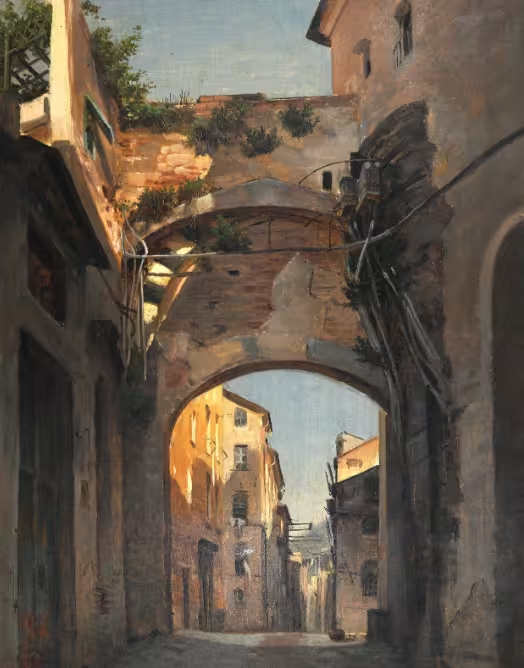
The most significant lost gate was Porta Aurea (the Golden Gate). Completed around 1161 alongside the other two main gates, it was identical in architecture, featuring the same majestic, semi-circular defensive twin towers and a soaring pointed central arch.
The gate stood on the lower slopes of the Sant’Andrea hill, protecting the southeastern entrance of the city, close to where the modern Piazza Dante and Via d’Annunzio are located today.
Unlike gates destroyed by wars, Porta Aurea fell victim to Genoa’s rapid urban growth. As the city expanded and new defensive walls were built further out, the gate was systematically swallowed by houses.
It was partially dismantled over the centuries, but the final, complete clearance occurred during the massive 1960s urban renewal of the Piccapietra and San Vincenzo districts. The last standing remnants of the structural towers were completely demolished to clear space for modern office blocks and roads.
The Secondary Gates (Posterle).
The Barbarossa system also relied on smaller, less fortified gates built into the curtain wall to allow merchants and locals access to specific areas without opening the massive main gates.
- Porta di San Donato: Located in the southern sector near the oldest district of the city (Castrum), this gate allowed access toward the sea and the hills. It was largely dismantled in subsequent centuries as newer, thicker Renaissance ramparts rendered the old 12th-century wall obsolete.
- Porta dei Superbi / Posterla di Sarzano: Positioned very close to the Piazza di Sarzano, this gate allowed access to the fields and shipyards just outside the 9th-century inner core. It disappeared piece by piece as the adjacent buildings expanded and incorporated the stone blocks directly into their basement foundations.
More than eight centuries after a frightened city raised a wall in four years, Porta Soprana still stands at the edge of the old town, its inscription issuing the same warning to anyone who approaches. The walls were obsolete within two hundred years and half-swallowed by the city they once protected — yet enough survives to trace the line the medieval Genoese defended. Start at Porta Soprana, climb its towers, then follow the old stones down toward Sarzano and the caruggi: you’ll be walking the exact edge of the old Republic.
For more of the old town, see our complete guide to things to do in Genoa, or explore the neighbouring Piazza di Sarzano.