

For centuries this was simply where Genoa met the sea — a working harbour of cargo, salt air and sailors, walled off from the city behind warehouses and customs sheds. Then Genoa handed the old port back to its citizens. Today the Porto Antico is the city’s open-air living room, and the single best place to start a visit.
The turning point came in 1992. For the 500th anniversary of Christopher Columbus’s voyage, the city commissioned its most famous living son — the architect Renzo Piano, Genoa-born and Pritzker-winning — to tear down the barriers between the city and its waterfront and reinvent the derelict old port as a public space. He gave it an aquarium, a panoramic lift, museums and wide stone promenades, and the Porto Antico (“old port”) has been the heart of the modern city ever since.
It’s free to wander at any hour, walkable from the cruise terminal and the old town alike, and it packs more headline attractions into one stretch of waterfront than anywhere else in Genoa. Here’s what to see, how to get there, and how to make the most of it.
Porto Antico at a glance
What it is
Genoa’s historic harbour, redeveloped by Renzo Piano in 1992 into the city’s main public waterfront.
Cost
Free to walk around, open-air, accessible day and night. Individual attractions (Aquarium, Galata, Bigo) are ticketed.
Time needed
An hour for a stroll; half a day or more with the Aquarium and a museum.
Best for
First-timers, families, cruise arrivals, sunset and aperitivo.
Where
Along the waterfront below the old town, between the cruise terminal and the Porta Siberia.
How to get there
Porto Antico sits directly below the old town, so most visitors simply walk down to it. From the old town and the caruggi, it’s a five-minute stroll seaward — head for Via San Lorenzo or Porta Siberia and you’ll come out on the water. From the cruise & ferry terminal, it’s an easy 10–15 minute walk along the front. From Genova Piazza Principe station, it’s about 15 minutes on foot, or one stop on the metro to San Giorgio or Darsena, which bookend the area. Drivers should use the Porto Antico car parks rather than attempt the old town.
What to see & do in Porto Antico
The attractions line up along the waterfront, so you can take them in order as you walk. The two ticketed heavyweights are the Aquarium and the Galata museum; everything else can be enjoyed for free as you go.
The Aquarium of Genoa
The biggest single draw in the city, and a near-guaranteed win with children: the Aquarium of Genoa is the largest in Italy and one of the largest in Europe, with sharks, dolphins, penguins and a walk-through of marine habitats. It’s busy — book online to skip the queue (tickets from around €29), and allow at least two hours inside.
The Biosfera
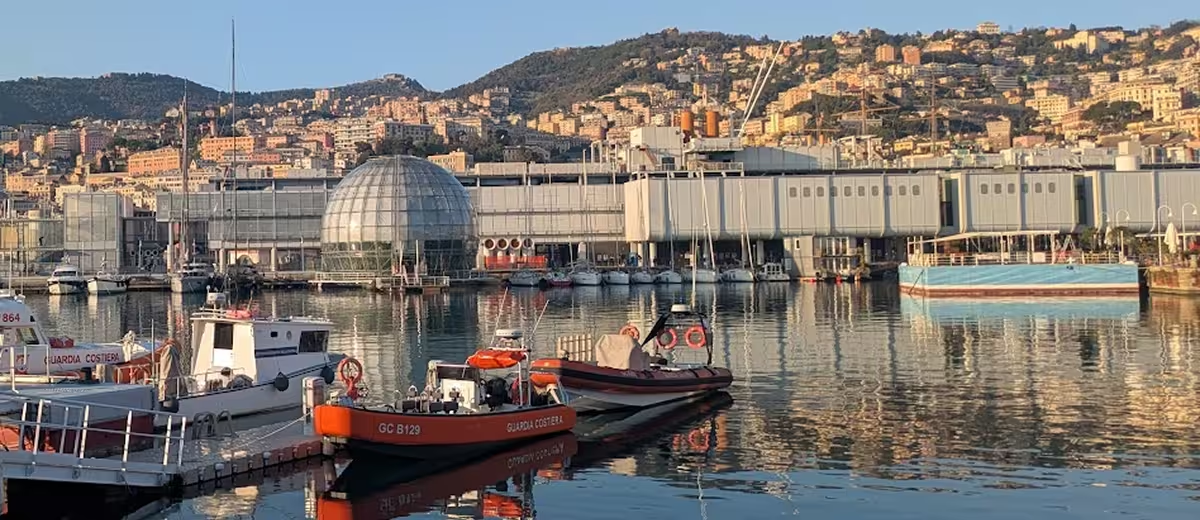
Next to the Aquarium, another building bears the signature of Renzo Piano: the Biosfera. It is a glass sphere floating at the water’s edge, a miniature tropical greenhouse of ferns, palms and birds. Quick and photogenic, it pairs naturally with the Aquarium next door.
The Bigo panoramic lift
One more Renzo Piano signature sits right on the water. The Bigo is a white, crane-inspired arm that hoists a rotating glass cabin some 40 metres up for a slow 360° view over the harbour, the rooftops and the hills behind. It is now perhaps the most recognisable landmark of Porto Antico.
The Isola delle Chiatte — the little island viewpoint
Walk past the Aquarium to the end of the pier and you’ll find one of the area’s quietest pleasures: the Isola delle Chiatte, a floating platform — another Piano design — set just off the quay. It’s free, usually calm, and gives you the best view back at the whole scene: the harbour in the foreground and the city rising up its steep amphitheatre behind. A fine spot to pause, and a lovely one at sunset.
The Galeone Neptune — the old galleon
Moored in the harbour is a full-size 17th-century Spanish galleon — or rather a perfect replica of one. The Galeone Neptune was built in 1985 for Roman Polanski’s film Pirates, and after its film career it found a permanent home here. You can climb aboard and explore the decks, rigging and cannon. It’s pure spectacle, hugely photogenic, and another reliable hit with kids.
The Galata Maritime Museum
For a city that lived by the sea, the Galata Museo del Mare is the obvious deep-dive: the largest maritime museum in the Mediterranean, telling the story of Genoa’s seafaring through galleys, navigation, emigration and a real submarine, the Nazario Sauro, moored alongside for you to board. It’s a strong rainy-day option and easily a couple of hours on its own.
The Magazzini del Cotone & the marina
The long building running down one side of the harbour is the Magazzini del Cotone — the old cotton warehouses, now converted into a congress centre, a cinema, shops and a children’s science museum. In front of it the marina fills with boats, and the whole quay is where Genoese come to walk, eat an ice cream and take the air. It’s the everyday texture of the modern port, and the connective tissue between the headline sights.
San Marco al Molo & the old molo
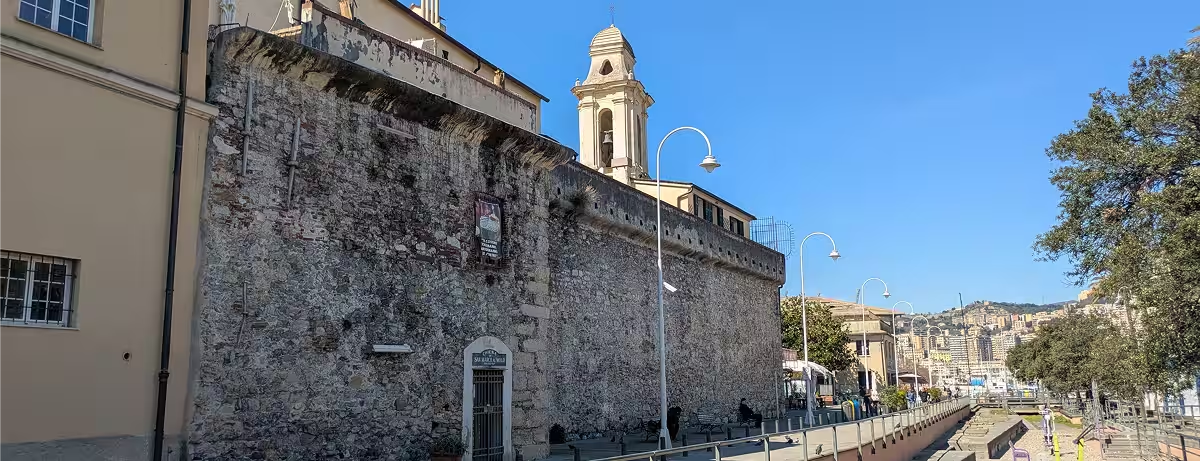
At the eastern end, where the modern port gives way to the old stone pier — the molo — stands the quiet church of San Marco al Molo, one of Genoa’s oldest, founded for the sailors and dockhands who once worked here.
It’s a calm, deeply local corner away from the crowds. Look out, too, for the so-called Casa del Boia — the “executioner’s house,” a squat medieval tower nearby that legend ties to the city’s hangman, though historians are far from sure the story is true.
→ Read more: San Marco al Molo, the sailors’ church
Palazzo San Giorgio
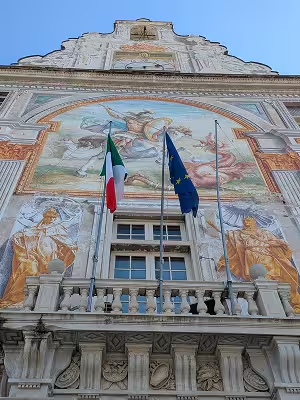
Facing the port stands one of Genoa’s most striking buildings: the Palazzo San Giorgio, a medieval palace whose seaward facade is covered in a vivid painted fresco of Saint George and the dragon. Built in the 13th century, it became the seat of the Bank of San Giorgio — one of the oldest banks in the world and once a financial power that rivalled states. It carries a famous legend too: a captive Marco Polo is said to have dictated the tales of his travels while held prisoner in Genoa, in this very building. It’s a landmark worth crossing the road for.
A short history of the old port
Genoa was one of the great maritime republics, and for the better part of a thousand years this harbour was its engine — the point from which Genoese ships, bankers and merchants reached across the Mediterranean and beyond. By the 20th century, though, modern shipping had moved west to vast container terminals, and the old port was left cut off from the city: derelict, fenced, and shadowed by an elevated motorway along the front.
The 1992 Columbus anniversary became the chance to put it right. Renzo Piano’s redevelopment opened the waterfront back up to the public and gave it the aquarium, the Bigo and the promenades you walk today — turning a forgotten industrial edge into the city’s most popular gathering place. What you see now is a deliberate layering of old and new: medieval stone and a working marina alongside Piano’s white steel and glass.
Good to know — the waterfront is about to change again
Porto Antico is still divided from the city by the Strada Sopraelevata Aldo Moro, the elevated road that runs along the front. That’s set to change: Genoa is building the Tunnel Subportuale, an undersea bypass to carry traffic beneath the harbour. Its final design was approved in January 2026 and the project is now out to tender, with the road targeted to open around 2029. Once it’s running, the elevated waterfront road is expected to be at least partly removed — finally reconnecting the city to its sea — though its full fate is still being debated. Expect works and changes around the area in the coming years.
Food, drink & aperitivo by the water
Few things are more Genoese than an aperitivo as the sun goes down, and Porto Antico is one of the easiest places in the city to have one — a spritz at a table on the quay, boats in front of you, the hills turning gold behind. The bars and restaurants along the harbour are more about the setting than great cooking, so for the real food of Genoa — focaccia, farinata, pesto — duck up into the old town just behind.
Visiting with kids, or on a rainy day
Porto Antico is the most child-friendly corner of Genoa: the Aquarium, the pirate galleon, the Bigo lift and the children’s science museum in the Magazzini del Cotone are all within a few minutes of each other. It’s also your best bad-weather fallback — the Aquarium and the Galata museum are large indoor visits that can each fill a wet half-day with ease.
Nearby next
Nearby nextWhen you’re done at the water, head straight up into the caruggi — Genoa’s old-town alleys, visit the striped marble Cathedral of San Lorenzo a few minutes uphill, or follow our pick of the city’s hidden gems in the old town.