
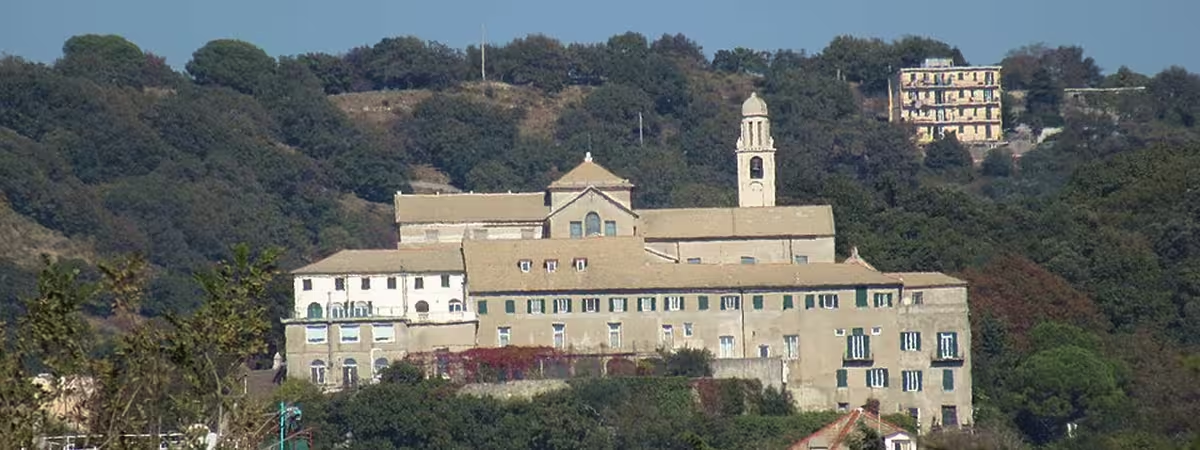
The Sanctuary of Nostra Signora del Monte (Our Lady of the Mount) is an ancient and important abbey located on an eminence overlooking the San Fruttuoso district. Its setting within a natural area, the remarkable Baroque interior of the sanctuary, and the splendid views of the city make it an excellent excursion point when visiting the eastern part of Genoa.
Church address.
Salita Nuova di Nostra Signora del Monte, 15
Church Opening times.
Tuesday, Thursday, Saturday and Sunday
From 9 am to 12 pm and from 3.30 to 6 pm
Best time for sun lighting
Afternoon

Excursion: From San Fruttuoso to the Sanctuary.
The convent is an excellent choice for a 3 hours excursion.
You can begin at the Mercato Terralba to enjoy its authentic atmosphere. From there, take the Passo Resa di Villa Migone and turn right onto Via San Fruttuoso. You will pass Villa Migone, a prime example of the 19th-century Genoese bourgeois style. In 1945, it served as the provisional seat of the Genoese Curia, as the Archbishop’s Palace had been severely damaged by aerial bombings. Considered neutral ground, it was chosen for the signing of the surrender of German troops to the Ligurian CLN (National Liberation Committee) on April 25, 1945.
Continue along Via San Fruttuoso and enter the park of Villa Imperiale. Belonging to the Imperiale family – one of the most important dynasties in Genoa – it was built in the 16th century. Now a library, it preserves remarkable frescoes. Don’t hesitate to take a look if you find it open. Open: Monday to Thursday, 8:30 am to 6:00 pm; Friday, 9:00 am to 2:00 pm. After reaching the upper part of the park, exit onto Via Imperiale and begin the climb. Along the way, you will see several Stations of the Cross built by the Saluzzo family in the mid-18th century.
Leave Via Imperiale for the Salita Nuova di Nostra Signora del Monte. Among the modern buildings, you will spot several 19th-century villas. Just past Villa Andrei, a viewpoint offers a beautiful vista of the city. Keep climbing to reach the Sanctuary. After visiting the church, you can continue to the cemetery or the Bosco dei Frati. To return, you can follow the Salita Vecchia back to San Fruttuoso. It will lead you to Via Giovanni Torti, where several bus lines pass.
History of the Sanctuary and the convent.
The history of the Madonna del Monte is a dramatic chronicle of holy visions, aristocratic ego, and gunpowder.
Nostra Signora del Monte in the Middle Ages.
According to local folklore, a modest chapel first crowned the mount in 958. But it wasn’t until 1183 that the Mortariensian Canons – a religious order from Lombardy – turned the hilltop into a proper priory.
By 1440, the site had crumbled into ruins, but its luck was about to change. Through the political maneuvering of Doge Raffaele Adorno, the Pope handed the keys to the Friars Minor. They launched a massive reconstruction of the convent and church, completed by 1444. The mystical aura of the place deepened over the following decades. Locals claimed to witness “mysterious lights” flickering over the mountain in 1440, 1525, and 1566. This spiritual prestige was further bolstered in 1461 by the transfer of precious treasures from the Genoese colony of Pera as it buckled under Ottoman pressure. These most remarkably included rare manuscripts and the sacred relic of the arm of Saint Anne, the mother of Mary.
The tumult of modern times.
In the following centuries, the church became a prestigious ‘city of the dead’ for the Genoese elite, who commissioned lateral chapels to house their familial tombs. Between 1654 and 1658, the church was reconstructed in its current baroque style, with the financial support of the Negrone and Saluzzo families, who also gave precious artworks. The iconic campanile that still dominates the complex was also erected at that time.
The 18th century brought the smell of powder to the sanctuary. During the 1746-1747 Siege of Genoa, the convent’s spiritual peace was shattered when it became a strategic prize for the attacking Austrians and Piemontese forces, seing its high vantage as a key location to bombard the city and its fortifications. Protected by trenches, the convent was defended by the Genoese and French, who managed to successfully repel the enemy’s assault until the siege was lifted.
Again, the 20th century brought war to the complex. The bombings of Genoa in 1942-1943 caused severe damage to the church and the convent. In 1946, while the complex was being renovated, Pope Pius XII officially recognized the sanctuary’s importance by elevating it to a minor basilica. Yet, after a remarkable 578-year tenure, a major chapter closed on September 25, 2022, when the Friars Minor finally departed, leaving the ancient convent silent for the first time in centuries.
Visiting the church.
Church exterior and forecourt.
The double-sloped facade of the church, pierced by three portals and five windows, reflects its 17th-century reconstruction. It appears plain, decorated only with rather clumsy frescoes featuring porticos.


The church overlooks a parvis offering sumptuous panoramas of the city and the Val Bisagno below. In front of the church, a typical Ligurian risseu of black and white pebbles features the coat of arms of the Republic of Genoa, the Franciscan symbol, and a large “M” for Mary, to whom the church is dedicated. A plaque also commemorates the visit of the King of the Two Sicilies, Ferdinand IV of Bourbon, who hunted in the area in 1785.
Interior of the sanctuary: A Jewel of the Baroque.
Restorations in the 1970s have brought to light some remains of the first medieval church. It had a unique nave, located under the current right one. But the current interior of the church is a masterpiece of Genoese baroque, and the true jewel of the complex.
The interior, conceived by the architect Ghiso, features a latin cross plan. In the first decades of the 1900s, the pyramidal dome was adorned by paintings. During the second world war, bombings destroyed the vaults and frescoes of the central nave. The current frescoes from G.B. Semino dates back to the post-war renovations.

The sanctuary was a pantheon for the Genoese nobility. Many of the burials belonging to patrician families have been removed, but the Church still holds significant funerary monument. Among these families are the biggest names of Genoa: the Negrone and Saluzzo, who were the primary patrons of the 17th century reconstruction, the Adorno, de Franchi, di Negro, Fieschi, Grimaldi, Imperiale, and others were represented in the sanctuary.
The crypt and the choir.

The crypt houses the 15th-century wooden statue of the Madonna del Monte. It is attributed to the Sienese artist Francesco di Valdambrino. The vault of the crypt is decorated with frescoes of the Stories of the Virgin, from the early 17th century, by Giovanni Andrea Ansaldo.
Above, the elevated choir is accessible with two lateral staircases. Its high altar is a masterpiece in polychrome marble, realised by the brothers Giovanni and Giovanni Battista Orsolino. They also sculpted the statues of Saint James and Sait Francis standing above the netrances. The choir features carved wooden stalls from the Abbey of San Nicolò del Boschetto in Val Polcevera. On the back wall, the Assumption is a Baroque masterpiece by Domenico Fiasella in 1632.
The presbitery and the museum.
The walls of the presbytery display paintings by Bernardino Fasolo (Saints Sebastian, Roch, and Pantaleon, 1618) and Giovanni Battista Casoni (Saints Bernardino of Siena, Anthony of Padua, and Salvator of Horta, 1668). It also hosts a small museum.
The monastic enclosure and its surrounding.
The convent.
It still preserves its 15th-century structure today. Next to the church, a restaurant amenaged in a part of the ancient monastic buildigns offers sweeping views of Genoa and the coast is a perfect spot for lunch or dinner.
The Bosco dei frati (Friars’ Wood).
Raffaele Adorno originally donated the land that would become the Bosco dei Frati to the convent in 1444. The friars planted it with holm oaks and various Mediterranean species. Today, it is for the most part a public park owned by the Municipality of Genoa.
The Salita Nuova.
In the mid-18th century, the Saluzzo family commissioned the construction of the road called the “salita nuova”, with a series of chapels corresponding to the stations of the Cross.
The Cemetery.
Opening Hours: Open only on Sundays and public holidays from 8:30 am to 1:00 pm (last entry 30 mn before closing). Closures: Closed on January 1st and 6th, Easter Monday, May 1st, June 2nd and 24th, August 15th, and December 8th and 26th.
The cemetery is situated further above the monastery on the Salita Nuova. It features the monumental enclosure of the Negrone family and is still active today.
