
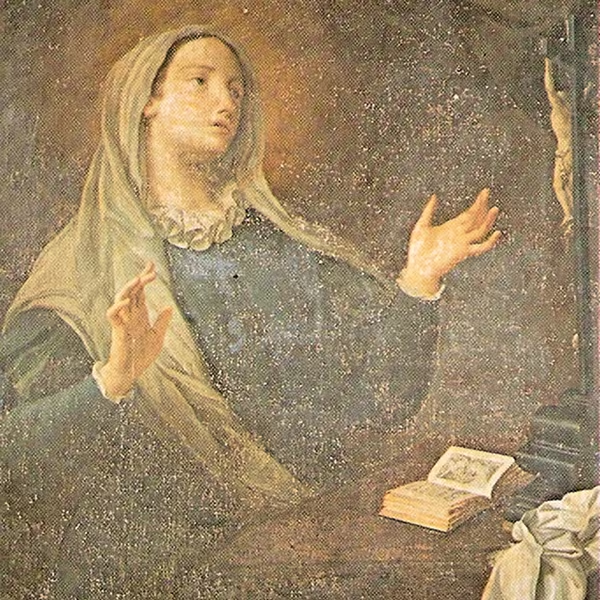
She was born into one of the most powerful families in Italy. The Fieschi had given the world two popes, a viceroy of Naples, and centuries of aristocratic prestige. For a girl like Caterina, born in Genoa in 1447, life was mapped out in advance: a strategic marriage, a noble household, and a comfortable distance from the suffering of the world.
Early Life and a Disastrous Marriage
It did not go that way. Her marriage to Giuliano Adorno, arranged to end a feud between two rival families, was a quiet disaster. Giuliano was unfaithful, violent-tempered, and a spendthrift who steadily dismantled the family’s finances. For five years, Catherine endured in silence. For another five, she sought distraction in Genoese high society. Neither path offered her anything close to peace. Desperate, she reportedly prayed for three consecutive months that God would simply keep her ill in bed — anything to escape her circumstances. The prayer went unanswered.
The 1473 Revelation
Then, on 22 March 1473, everything changed. During a routine confession, Catherine experienced what she would later describe as an overwhelming, almost physical sense of God’s love — an interior revelation so sudden and so total that she walked out of the church mid-confession, unable to finish. She was 26 years old, and something in her had permanently shifted.
What followed was not a retreat into contemplative quiet. Catherine plunged into action. She began taking Communion nearly every day, an almost unheard-of practice for a laywoman in the 15th century. She started working in Genoa’s hospitals, tending to the sick and dying. And in one of the stranger grace notes of the story, her husband Giuliano — the faithless, ruinous man who had made her life miserable — eventually underwent his own conversion, joined her in her charitable work, became a Franciscan tertiary, and died in 1497 as director of the very hospital where Catherine labored.
Running the Pammatone Hospital
That hospital was the Pammatone, founded in 1420 and, by Catherine’s lifetime, the largest and most important charitable institution in Genoa — a sprawling complex in the Portoria district that treated the city’s sick and destitute on a scale few Renaissance hospitals could match. Catherine and Giuliano moved in together, and she rose to become its manager and treasurer: an extraordinary position of responsibility for anyone of the era, let alone a noblewoman with no formal religious vocation and no order behind her.
The Pammatone itself no longer stands. It survived into the early 20th century, then served for a time as home to Genoa’s Faculty of Economics before being badly damaged in the Allied bombing raids of 1942–43. In the redevelopment of the Piccapietra district that followed, what remained was cleared in the 1960s to make way for Genoa’s Palazzo di Giustizia, the city’s law courts, completed in the 1970s. But the builders kept a deliberate trace of the old hospital: the 18th-century courtyard, its colonnade, the monumental staircase, and several statues of Pammatone’s benefactors are still incorporated into the modern courthouse. Anyone walking into that building today is, in a literal sense, walking into the shell of the institution Catherine once ran.
Surviving Genoa’s Plagues
When the plague struck Genoa in 1497 and again in 1501, Catherine did not leave. She stayed, worked, and cared for the sick at considerable risk to her own life. The city burned around her and she remained, not out of resignation, but out of something that looked, to those who witnessed it, a great deal like joy.
This is the paradox at the heart of Catherine of Genoa. Her mysticism was not ethereal or detached from reality. It was embodied, physical, relentlessly practical. She ran a hospital. She managed accounts. She handled the logistics of care for hundreds of sick and destitute people. And she did all of this while experiencing interior states so intense that contemporaries struggled to describe them — visions, prolonged suffering, weeks spent wavering, as her biographers put it, between life and death.
She died on 15 September 1510, worn out, by every account, in both body and soul.
Catherine of Genoa’s Legacy and the Church of Saint Catherine
Her influence took time to travel. In 1551, forty-one years after her death, a collection of her writings and the accounts of those close to her was published in Genoa. It contained her Dialogues on the Soul and the Body and her Treatise on Purgatory — the work for which she would become most widely known. Her vision of purgatory was strikingly original for her time: not a place of punishment, but a state of willing, even grateful purification, a movement toward God that the soul itself desires.
Francis de Sales drew on her thought. Robert Bellarmine read her. Cardinal Manning kept her writings close. In 1908, the Austrian philosopher Baron Friedrich von Hügel devoted his landmark study The Mystical Element of Religion almost entirely to her life and teaching, cementing her place in the canon of Western mysticism. She was beatified in 1675, canonized in 1737, and declared patroness of Italian hospitals by Pope Pius XII.
Her body rests today in the church originally known as the Santissima Annunziata di Portoria, renamed in her honor as the Church of Saint Catherine, standing a short distance from the site of the Pammatone. The mausoleum housing her remains is an 18th-century shrine of bronze and crystal, set within a Carrara marble ensemble carved in 1738 by the sculptor Francesco Maria Schiaffino. Four allegorical statues — Divine Love, Strength, Obedience, and Penitence — flank the altar; the tabernacle and candelabra were added in the early 19th century by Ignazio Peschiera. The chapel that holds it dates back further still, founded in 1490 and frescoed by Pantaleo Calvi. Today the church stands almost in the shadow of the Palazzo di Giustizia next door — so that the site of her burial and the site of her life’s work remain, five centuries later, only steps apart.
There is something quietly radical about Catherine of Genoa that centuries of official sanctity have not entirely smoothed over. She never became a nun, and she held no title within the Church. Instead, she was a noblewoman who moved into a hospital, buried her difficult husband, survived two plagues, and ran an institution — all while insisting, in her writings, that love was not a feeling but a force, something closer to gravity than to sentiment. She also remains one of the most prominent women in the centuries-long history of Genoa’s patriarchal society.
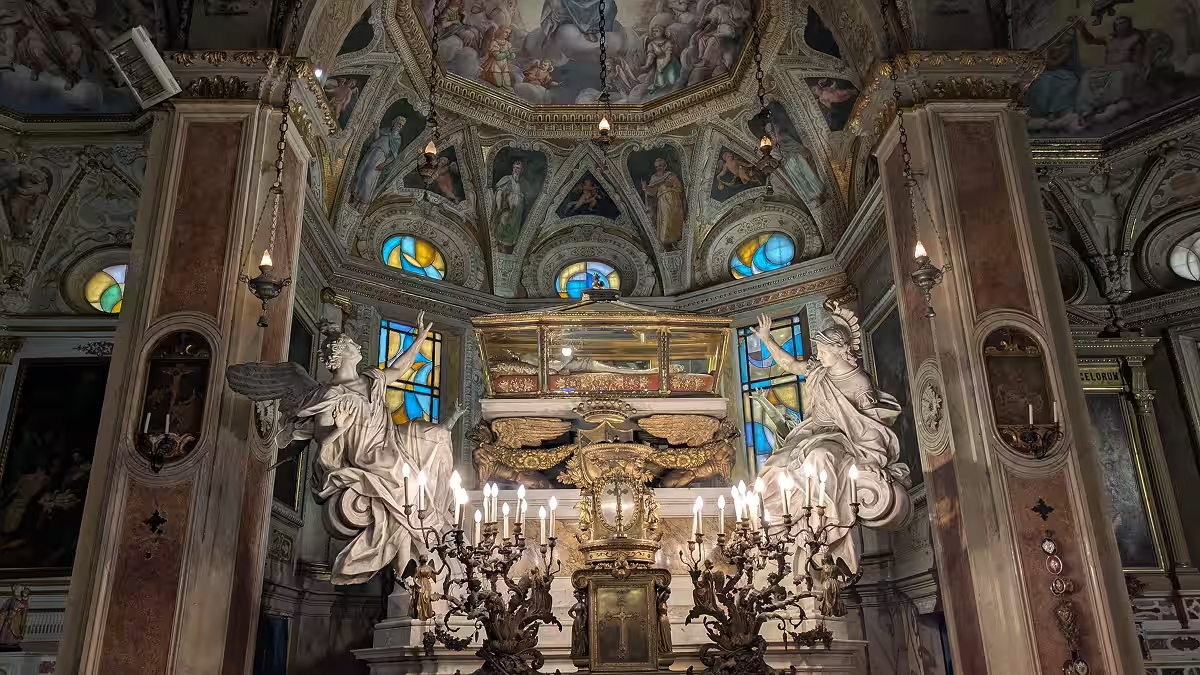
Where is Catherine of Genoa buried?
Her body rests in the Church of Saint Catherine (originally the Santissima Annunziata di Portoria) in Genoa, in an 18th-century mausoleum by the sculptor Francesco Maria Schiaffino.
What happened to the Pammatone hospital where she worked?
The Pammatone was badly damaged in WWII bombing and demolished in the 1960s during the redevelopment of Genoa’s Piccapietra district. Genoa’s Palazzo di Giustizia (law courts) now occupies the site, incorporating the hospital’s original 18th-century courtyard, colonnade, and staircase.
Was Catherine of Genoa a nun?
No. She was a married noblewoman who never took religious vows or joined an order — an unusual path to sainthood for her era.