
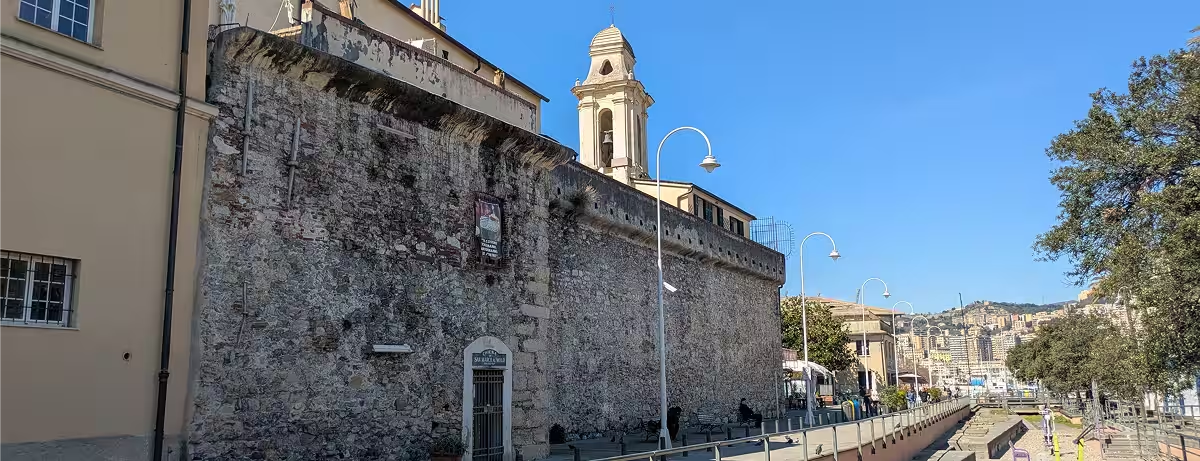
Located close to the Porto Antico, the Church of San Marco al Molo is the only religious monument surviving in the Molo area, the peninsula that once closed the harbour of Genoa to the south-east. Integrated into the medieval defensive system of the city, it was rebuilt in the Baroque period and severely damaged during the bombing raids of World War II. While it isn’t one of Genoa’s most remarkable churches, it’s worth a look if you find it open while strolling the Porto Antico – one of the smaller things to do in Genoa that reward a curious wander.
Church address.
Via del Molo, 18
Opening times.
Monday, Thursday, Saturday and Sunday from 10 am to 12 pm and from 4 and 6 pm
Wednesday from 10 am to 12 pm
Friday from 4 to 6 pm

History of the Church of San Marco.
The Church of San Marco al Molo dates back to the 12th century, erected under Archbishop Ugone della Volta between 1163 and 1188. It was most likely aiming at serving the community living and working in Genoa’s expanding port district. At the time, the church stood directly on the first artificial extensions of the Molo pier, facing the quayside. As the pier grew outward over the centuries, it found itself increasingly inland.
The dedication to Saint Mark raises an eyebrow: he was the patron saint of Venice, Genoa’s most bitter rival. Whether this was a provocation, a coincidence, or simply a gesture of ecumenical goodwill, history does not say. The founder of the church died in 1178 and was buried at its entrance – a privilege befitting his status. Nearly four centuries later, in 1571, his descendants of the noble Salvago family placed a commemorative plaque on the site.
The 16th century brought dramatic changes. The construction of Genoa’s new city walls completely enclosed the church, cutting it off from the port wharves it had once faced. Its orientation was likely reversed during this period – the current entrance now stands where the apse once was. A series of interventions in 1594, 1646, and 1736 gradually transformed the Romanesque building into a Baroque one. A crossing tower, already in precarious condition, was demolished in 1783.
The church’s surroundings had a darker side. Until the mid-19th century, the Old Molo served as Genoa’s site for capital executions, and the condemned would receive their final blessing from the pastor of San Marco. A plaque dating from 1654 records that the priest was bound to a sombre duty: celebrate a requiem mass for the executed every Saturday and on the 2nd of November each year.
Bombing raids on the harbour during World War II caused severe damage to the walls and roof. Restoration work carried out between 1947 and 1948 stripped plaster from the stone columns and arches, revealing the original interior structures in the black stone of Promontorio. During this work, the foundations of the original apse were discovered near the current main entrance, confirming the earlier reversal of the church’s Romanesque orientation. A white marble strip set into the floor now quietly marks where the ancient apse once stood.
Visiting San Marco al Molo.
Exterior of the church.
Look at the facade parallel to the port. The exterior is massive, without windows or decoration. This side of the church was integrated into Genoa’s new city walls in the 16th century, hence its imposing appearance. Due to the scarce space within the protected area, residential apartments were even built on the upper floors.
Move to the main facade of the monument. It dates to 1594, but incorporates a medieval portico from 1346, once used for administrative meetings. On the left side, along the Via del Molo, the wall features a bas-relief of the Lion of Saint Mark, taken from the city of Pola in 1380 during the War of Chioggia against Venice. Several inscriptions are also embedded in the wall. The original Romanesque tower was an octagonal structure built over the crossing, similar to that of San Donato. After its demolition in 1783, it was replaced by the current tower-style campanile.

Interior of the church.
In Romanesque times, the apse stood where the entrance is now, but the orientation was reversed during the Baroque restructuring. The foundations of the original apse were uncovered during restoration work carried out after World War II, and are marked by a strip of white marble set into the floor.
The interior retains a basilica plan with three aisles separated by rustic stone columns with cubic capitals. The 18th-century barrel vault replaced the original wooden trusses.
The church preserves notable works from the Baroque period, spanning the 17th and 18th centuries. The most notable are:
- The Assumption: a wooden statue by Anton Maria Maragliano (1736).
- Madonna and Saints Nazario and Celso: a marble group by Francesco Maria Schiaffino (1735), commissioned by the guild of ship-caulkers.
- Martyrdom of Saint Barbara: an early work by Domenico Fiasella (1622), commissioned by the Bombardieri (artillerymen) guild.
- Mystic Marriage of Saint Catherine: by Orazio De Ferrari (c. 1630).
- Madonna del Soccorso: an altar by Daniello Solaro (late 17th century), featuring a painting by Giovanni Carlone.
 Martyrdom of Saint Barbara by Domenico Fiasella
 Altar of the Madonna del Soccorso:
 The Assumption by Maragliano