
Genoa is a city of layers, where medieval alleys meet industrial giants. Nowhere is this clearer than in the story of the Church of San Teodoro. Once a lonely Romanesque outpost on a cliff, it was eventually swept aside by the march of progress, only to rise again. Today, it stands as a testament to a community that refused to let its heritage disappear for the sake of modernity.
Church address.
Via Venezia, 3
Opening times.
Closed on Monday.
All other days: 7:30 am – 1 pm and 4:30 – 7 pm.

A Romanesque sentinel by the sea.
The story begins in the 10th century. Long before the modern port existed, the original church of San Teodoro and San Salvatore sat on a rocky outcrop in the Fassolo district, literally overlooking the waves. In 1097, Bishop Airaldo Guaracco entrusted the site to the Mortariensi canons – the same that would take over Nostra Signora del Monte. In 1100, a beautiful Romanesque church was consecrated.
For centuries, this was a place of prestige. Powerful families like the Lomellini poured wealth into its chapels. In the early 1500s, they even commissioned the legendary Filippino Lippi to paint the “Martyrdom of Saint Sebastian” – a masterpiece that survived Napoleon’s looters and now rests in the Palazzo Bianco gallery.
Trapped between walls and waves.
Positioned on the water’s edge, the church was vulnerable to both waves and urban shifts. A brutal storm nearly destroyed it in 1596; then, in 1630, the construction of Genoa’s new defensive walls physically engulfed the building. This architectural shift cut the church off from the sea, trapping it within the city’s fortified perimeter
The 19th century brought even bigger challenges. First came Napoleon’s troops, who suppressed the monastery in 1797. Then came the urban planners. As Genoa grew toward the west, the quiet Fassolo road was widened, and the church suddenly found itself sitting below the level of the new street. To enter the sanctuary, parishioners literally had to walk downhill into the past.
The Great Explosion of 1870.

By the mid-1800s, the Port of Genoa required space for its new “Magazzini Generali” (General Warehouses). The San Teodoro area needed to be remodeled, and the ancient church stood directly in the path of the industrial revolution. On October 4, 1870, a massive crowd gathered to witness a somber spectacle.
Using gunpowder charges, engineers demolished the Romanesque landmark to make room for the expanding docks. It was the end of an era, but San Teodoro was not the only casualty of progress; that same year, the nearby Church of San Lazzaro met the exact same explosive fate.
However, while San Lazzaro vanished from the map forever, San Teodoro’s story took a different turn. A new church was commissioned just a short distance away, serving as a “new shell” to house the traditions, art, and resilient spirit of the old congregation.
The neogothic church of San Teodoro.
Rising from the rubble of its 1870 demolition, the new Neogothic Church of San Teodoro was reconstructed by architect Vittore Garofalo and consecrated in 1876. This resilient sanctuary survived the aerial bombardments of World War II and was later adorned with vibrant stained glass by Amalia Panigati and a refined travertine facade designed by Angelo Sibilla in 1963. While the Lateran Canons had faithfully stewarded the parish for over five centuries, a historic transition occurred in August 2013 when the Institute of the Incarnate Word took over, ensuring that San Teodoro continues to preserve the ancient spiritual legacy of the district.
Visiting the church.
As the only church in Genoa built in a pure Neogothic style, San Teodoro´s architectural presence is unique. The tripartite facade is clad in smooth travertine and dominated by a soaring central bell tower with a pyramidal spire. Three grand portals lead the way inside, each topped by an elegant single-light window, while the traditional slate roof rests on a sturdy timber frame.
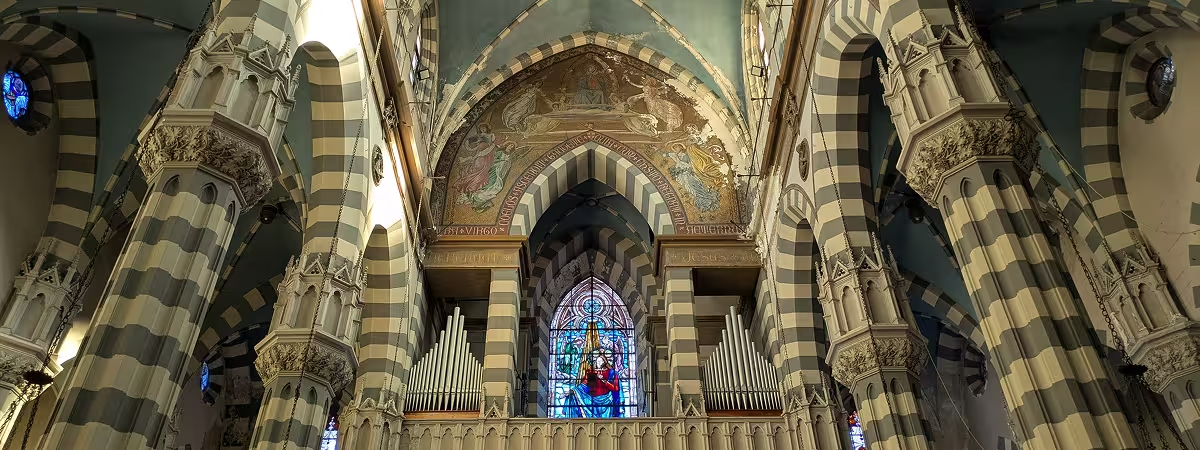
Stepping inside, the interior opens into three spacious aisles divided by eight octagonal ribbed pillars. These support striking black-and-white striped pointed arches, a classic stylistic nod to Genoa’s medieval aesthetic. The space is anchored by a polygonal apse and thirteen altars, creating a rhythmic and solemn atmosphere that feels both airy and grounded.
 Porch of the church.
 View of the interior.
While most of the building´s decoration dates back to the 19th-century and 20th century, the heart of the church is filled with “old treasures” rescued from the original building and other lost sites. As you walk through, look for:
- Renaissance inscriptions and funerary monuments: In particular, two exquisite 16th-century tombs belonging to the Lomellini family, crafted by masters Antonio Della Porta and Pace Gaggini, can be seen next to the right entry of the church.
- A notable altarpiece by Luca Baudo depicting Saint Augustine alongside Saint Monica and Saint Ambrose, located in the choir.
- Commanding the high altar is a magnificent wooden sculpture group of the Virgin Surrounded by Angels. Emerging from the renowned workshop of Maragliano, this piece was salvaged from the now-lost Church of Santa Maria della Pace, finding a permanent home in this resilient Neogothic sanctuary.


