
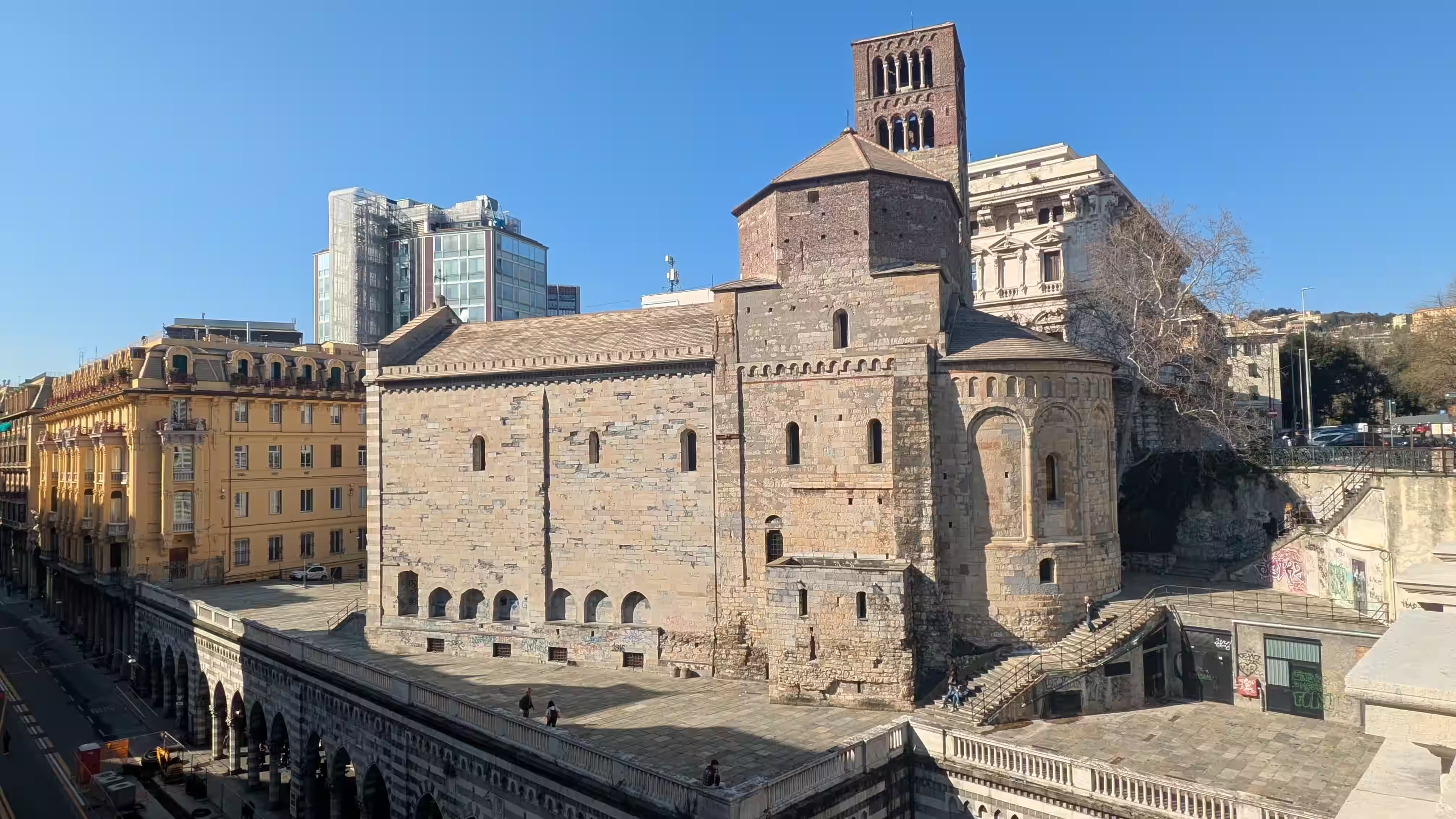
Situated on a hill overlooking the central Via XX Settembre, the Abbey Church of Santo Stefano is an ancient monument and one of the most significant examples of Romanesque architecture in Genoa. According to local tradition, both Christopher Columbus and Balilla – the boy who allegedly sparked the 1746 riot against the Austrians – were baptised in this church. Though it suffered from the modernisation of the city and the bombardments of the Second World War, it remains an iconic landmark of the San Vincenzo area.
Church address.
Piazza Santo Stefano, 2
Church Opening times.
Usually on the afternoon.
Best time for sun lighting
Afternoon

History of the Church and Monastery of Santo Stephano.
In the 5th century, a small church dedicated to Saint Michael the Archangel stood on the site. Some scholars believe the bell tower may have originally served as a Byzantine defensive fortification for the Ligurian province. Following the Lombard conquest around 640-643, these military strongholds were often repurposed, and small churches were frequently erected on these sites.
Bishop Teodolfo of Genoa initiated the construction of a new church and abbey in 972 to remedy the destruction caused by a Saracen raid in 934. From the 11th century onwards, wealth flowed into the monastery, which began to own vast territories along the Ligurian coast, especially through the donations of Countess Adelaide of Susa. It became a parish after 1054 and was rebuilt in 1217 following the model of the abbey church of Bobbio. It was reconsecrated by Cardinals Ugolino Conti (future Pope Gregory IX) and Sinibaldo Fieschi (future Pope Innocent IV), and the church was gifted a relic of Saint Stephen’s arm contained in a Byzantine silver casket.
The abbey started to decline in the 15th century. It became a “commenda” – entrusted to laics – then in 1530 was entrusted to the Abbey of Monte Oliveto Maggiore, close to Siena. In 1535, the old buildings of the monastery were demolished and rebuilt in the mid-17th century at a higher elevation. In the church, a new floor was constructed above the ancient mosaic one, causing the crypt to disappear.
At the end of the 19th century, the area was deeply remodeled. The expansion of the Via XX Settembre required the demolition of the cloister, the monastery buildings, and even the chapels on the right side of the church, which gave it its asymmetrical look. Moreover, the nearby Porta degli Archi was dismantled and the slope connecting the churchyard to the street below was removed, replaced by the Monumental Bridge. In the meantime, significant restoration works were carried out by architect Alfredo d’Andrade. In 1904, a new church in a Romanesque-inspired style was built next to the old one. However, it was irreparably damaged during the bombardments of 1942 and 1943, while the old church lost half of its facade and much of its roof. The abbey church was renovated between 1946 and 1955.
Architecture and artworks of the church.
The church has a rectangular floor plan, with a single nave and a raise presbytery, above a crypt. The dome, rebuilt in brick in 1306, by Abbot Niccolò Fieschi, is octogonal. The bell tower´s lower section is of uncertain date, though it is believed to predate the church and originally served as a watchtower.

The interior appears pared down compared to the Baroque decoration of most churches in Genoa. Yet it still preserves notable Mannerist and Baroque paintings.
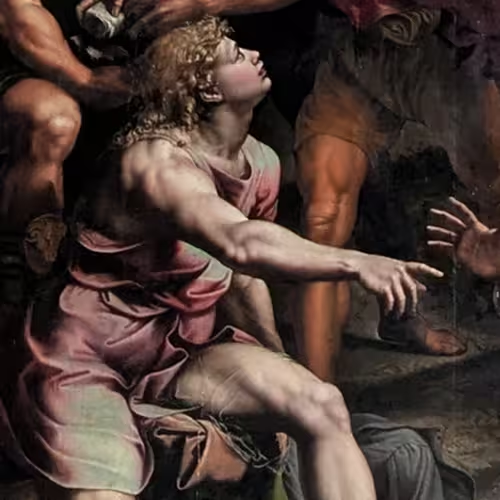
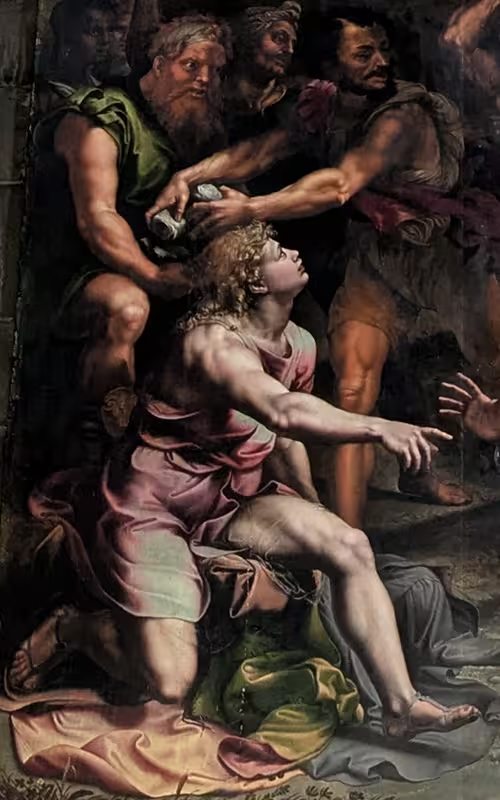
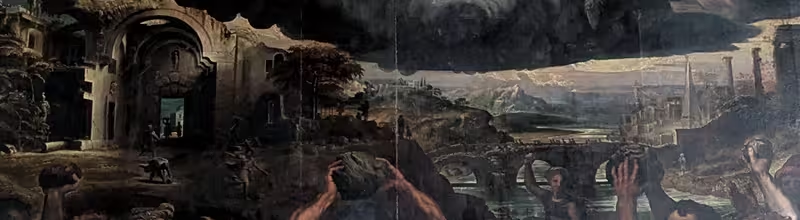
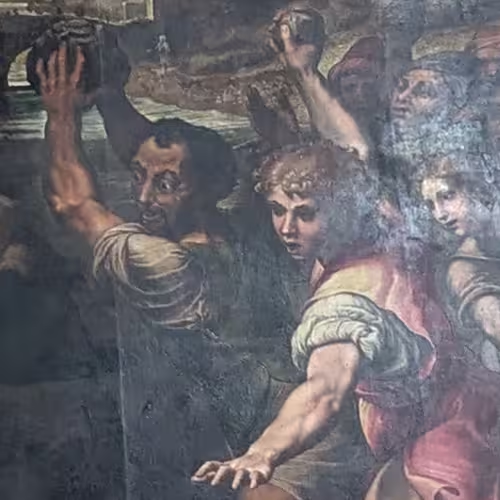
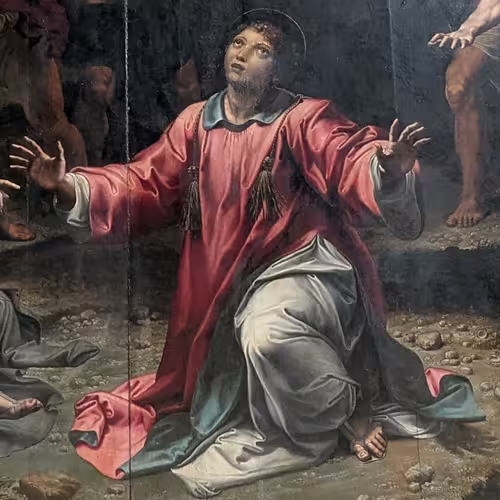
- The Stoning of Saint Stephen, by Giulio Romano (c. 1521)

The painting was commissioned by Giovanni Matteo Giberti (1495-1543), a highly influential figure who served as the secretary to Pope Leo X and a key papal advisor. The order was placed around 1519 to celebrate Giberti’s appointment as the commendatory abbot of the church of Santo Stephano, where the artwork was intended for the high altar.
It was originally envisioned for Raphael, but the death of the master in 1520 led to the project being completed by his protégé, Giulio Romano. He showcases in his work the dramatic tension and complex compositions that defined the transition from the High Renaissance to Mannerism.
The painting depicts the death of Stephen, the first Christian martyr, in 34 or 35. After a speech condemning the religious authorities of Jerusalem, he was dragged outside the city and stoned to death. This event triggered a major persecution against the Christians, forcing many disciples to scatter and thereby promoting the spread of the new religion.

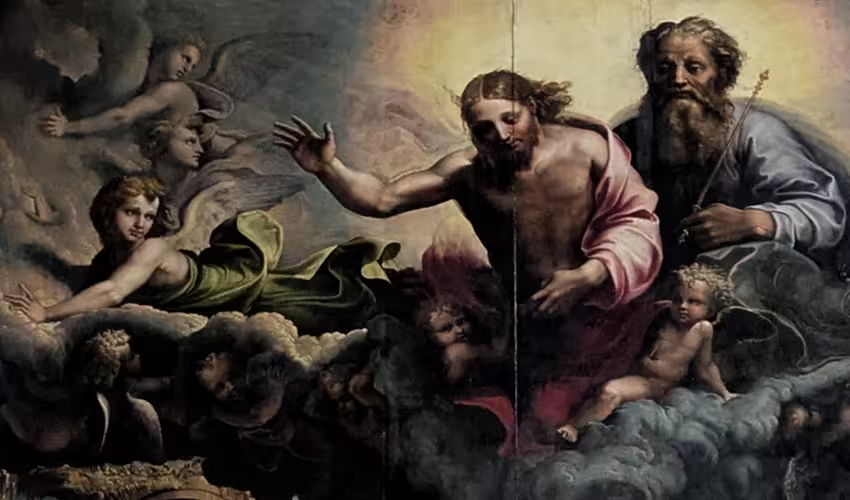
- The Martyrdom of Saint Bartholomew, by Giulio Cesare Procaccini
While the Stoning of Saint Stephen was born for this church, Procaccini’s masterpiece arrived via a much more turbulent path. Originally commissioned around 1618 for the Oratory of San Bartolomeo delle Fucine, the painting was uprooted when the oratory was suppressed, eventually finding a home in Santo Stefano. Its survival is nothing short of miraculous; after the heavy bombings of World War II, the canvas was held in military custody for decades, only returning to the church in 1981 to reclaim its place on the walls.
The man behind the brush was a powerhouse of the Italian Baroque who famously traded his sculptor’s chisel for a painter’s palette. This “sculptural eye” is his secret weapon, allowing him to render figures that feel carved from flesh rather than merely painted. By the time he arrived in Genoa as a high-profile guest of the billionaire patron Giovan Carlo Doria, Procaccini had perfected a high-voltage style: a blend of moody Milanese tension and the explosive, cinematic color of Peter Paul Rubens.
In this monumental altarpiece, Procaccini balances divine grace against a backdrop of raw, earthly brutality. While the bottom of the canvas depicts the unflinching cruelty of the executioners, the composition draws the eye upward toward a celestial rescue. There, Christ and his angels offer a spiritual anchor to the suffering below, while a flying angel supports the saint and presents him with the crown of martyrdom. It is a work of “beautiful discomfort,” where physical agony and heavenly ecstasy collide with peak Baroque energy.
The Resurrection, by Giovanni Battista Baiardo
The Miracle of Saint Benedict, by Luca Saltarello
The crypt of San Michele, the oldest part of Santo Stefano.
The crypt, located below the choir, is likely the original core of the small church of Saint Michael and one of the most interesting and ancient elements of the building.
For centuries, it was identified simply as a crypt, but modern research initiated after wartime destruction suggests a far more complex origin. Investigations led by the scholar Ceschi revealed that this space was likely not a crypt in its first iteration, but rather a small, independent church. Evidence shows that this early building consisted of only three aisles separated by two rows of columns, and was finished with exterior plaster. It appears that when the larger Romanesque church was commissioned in the 11th century, the builders chose to preserve this earlier sanctuary, incorporating it into the new foundation while remodeling the column levels to accommodate the new scale.
The masonry itself tells a story of diverse construction phases spanning several hundred years. The internal apse displays a high level of craftsmanship and superior materials, contrasting sharply with the crude pilasters that support the vaults. These structural additions are roughly worked, a style that dates them no later than the 10th century. Furthermore, the absence of an “annular” (curved) corridor – a standard feature for Italian crypts prior to the year 1000 – supports the theory that the space was originally a small apsidial hall rather than a traditional underground burial chamber.

Some elements of the medieval cloister, notably fragments of its columns and Romanesque capitals, were salvaged and are now preserved in the Museo di Sant’Agustino.
If you’re putting a trip together, this is just one of many things worth doing in Genoa — see the full guide for how it fits with the rest.